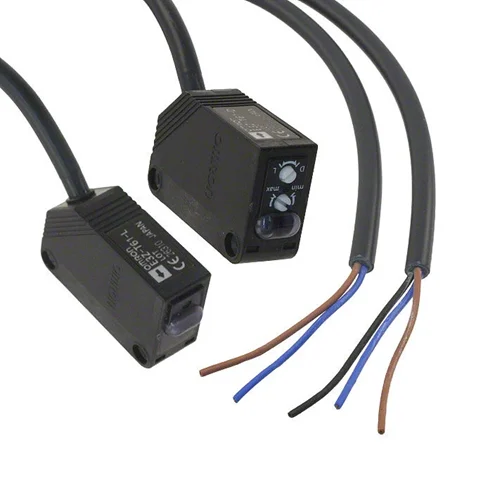
Omron E3ZG-T61-S 2M NPN Through-Beam Sensor

USD 29.50

Omron E3ZG-T61-S 2M is an NPN through-beam sensor set with 15 m sensing, 2 m cables, selectable Light-ON/Dark-ON and IP65 protection.

SKU Omron-E3ZG-T61-S 2M Category
Omron Photoelectric Sensors

Omron E3ZG-T61-S 2M Photoelectric Sensor

BrandOmron
Model IdentifierE3ZG-T61-S 2M
Official Part NumberE3ZG-T61-S 2M

Technical Overview

The Omron E3ZG-T61-S 2M is a compact photoelectric sensor with a built-in amplifier, NPN open-collector output and a pre-wired 2 m cable. Its separate emitter and receiver provide a 15 m optical detection path for opaque targets at least 12 mm in diameter. The infrared LED operates at 870 nm, and the sensor provides an operate or reset response time of 1 ms maximum. A one-turn sensitivity adjuster and selectable Light-ON or Dark-ON operation support setup. The PBT housing has IP65 protection and carries local indicator feedback for installation and operation.

15 m through-beam sensor with NPN output, 1 ms response and a 2 m cable.

Key Features

  • Through-beam sensing
  • 15 m nominal detection range
  • NPN open-collector output
  • 12–24 VDC ±10% supply
  • 1 ms maximum operate/reset response
  • 870 nm infrared LED
  • Light-ON / Dark-ON selectable
  • Pre-wired 2 m cable
  • PBT housing; IP65 protection

Obtain NPN optical detection feedback with 15 m through-beam coverage and a 1 ms maximum response.

Technical Specification Matrix

ParameterValue
Sensing methodThrough-beam
Sensing distance15 m
Optical arrangementSeparate emitter and receiver supplied as a set
OutputNPN open collector
Operation modeLight-ON / Dark-ON selectable
Light sourceInfrared LED, 870 nm
Power supply12–24 VDC ±10%; ripple peak-to-peak 10% maximum
Current consumptionEmitter: 15 mA maximum; receiver: 20 mA maximum; set: 35 mA maximum
Load rating100 mA maximum; load supply 26.4 VDC maximum
Residual voltage1 V maximum below 10 mA load; 2 V maximum from 10 to 100 mA
Response timeOperate or reset: 1 ms maximum
Sensitivity adjustmentOne-turn adjuster
Standard sensing objectOpaque object: 12 mm diameter minimum
IndicatorOrange operation and green stability indicators; emitter orange power indicator only
Protection circuitsSupply reverse-polarity; output short-circuit; output reverse-polarity protection
Ambient lightIncandescent: 3,000 lx maximum; sunlight: 10,000 lx maximum
Operating temperature-25 to +55 °C; no freezing or condensation
Storage temperature-40 to +70 °C; no freezing or condensation
Operating humidity35–85% RH; no condensation
Storage humidity35–95% RH; no condensation
Insulation resistance20 MΩ minimum at 500 VDC
Dielectric strength1,000 VAC, 50/60 Hz, for 1 minute
Vibration resistance10–55 Hz; 1.5 mm double amplitude; 2 hours per axis
Shock resistance500 m/s²; 3 times per axis
IP ratingIP65 (IEC)
HousingPBT
Lens materialModified polyarylate
ConnectionPre-wired 2 m cable
AccessoriesInstruction manual; mounting brackets sold separately

Industrial Applications

1. Conveyor object passage monitoring

A conveyor moves opaque products through a defined optical path formed by the separate emitter and receiver. Each product interrupts the received beam, and the NPN output provides a discrete passage event to compatible controls. The documented sensing range of 15 m sets the optical arrangement, while the 1 ms response provides the switching-time reference for the selected conveyor speed.

Problem Solved

Converts interruption of the optical path into a discrete product-passage signal, supporting conveyor tracking without requiring a mechanical actuator to contact each passing item.

Through-beam NPN output

2. Fixture loading occupancy check

A loading fixture needs to distinguish an occupied position from an empty one before continuing its process. The through-beam sensor observes a beam path across the intended opaque target area. Light-ON or Dark-ON wiring selects the output logic, and the one-turn sensitivity adjuster supports optical setup for the defined fixture geometry and target.

Problem Solved

Supplies a noncontact occupied-or-empty condition at the fixture, allowing the loading sequence to identify a missing opaque workpiece before the following machine step.

Fixture presence Selectable logic

3. Transfer chute accumulation detection

A transfer chute needs to identify material accumulating across a selected inspection line. The separate emitter and receiver establishes the optical path at that level, and accumulated opaque items interrupt the returned or transmitted light. The NPN switching state provides the accumulation condition to process controls, while the orange operation and green stability indicators assist local observation of the sensing state.

Problem Solved

Indicates when opaque material occupies the monitored chute line, giving the feed sequence a local accumulation condition without placing a contacting switch in the material flow.

Accumulation signal Optical path

Select your currency