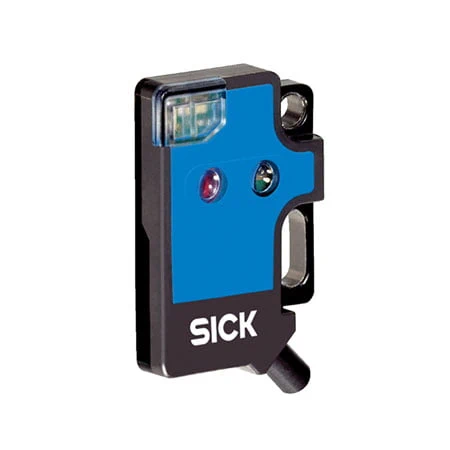
1. Checking component presence in a compact fixture
A small assembly fixture can position the sensor close to the expected surface of an opaque component. Reflected red light changes the NPN light-switching output when the component enters the sensing field. The 2–34 mm reference-target range supports local checks, and the thin housing fits beside mechanisms where a larger sensor would occupy useful working space.
Problem Solved
A short-range optical presence signal helps the controller confirm that a component occupies the fixture without adding a contact switch that touches the workpiece.
Short-range sensing
NPN light switching
2. Detecting passing tabs on a feeder
A feeder can present opaque tabs close to the sensing face so each tab produces a reflected-light event. The 1,000 Hz switching frequency and response of no more than 0.5 ms support distinct electrical transitions within the documented timing limits. Detection remains dependent on target remission and the tab passing within the short operating distance.
Problem Solved
The controller receives a discrete event as each qualifying tab passes the optical field, supporting feed tracking without mechanical contact against the moving material.
1,000 Hz
≤ 0.5 ms
3. Monitoring a parts magazine pickup level
A parts magazine can place the sensor beside the final pickup position to determine whether an opaque part remains at that location. The energetic sensing principle evaluates returned red light rather than requiring a separate receiver across the magazine. IP67 protection and the 2 m cable support mounting near the mechanical feed path.
Problem Solved
A change in reflected-light detection identifies an empty pickup location, allowing the controller to request replenishment or suspend the next pickup before a missing part disrupts the sequence.
One-sided detection
IP67