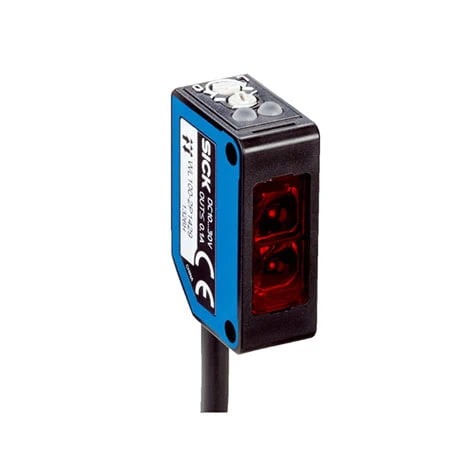
SICK 6052375 WT100-2N1419 NPN BGS Photoelectric Sensor

USD 103.22

WT100-2N1419 offers NPN background suppression, 10–100 mm reference-target range, 1,000 Hz switching, 2 m cable and mounting bracket.

SKU SICK-6052375 Category
SICK W100-2

SICK WT100-2N1419 NPN BGS Photoelectric Sensor

BrandSICK
Model IdentifierWT100-2N1419
Official Part Number6052375

Technical Overview

The SICK WT100-2N1419 is a background-suppression photoelectric sensor with a NPN switching output and a 632 nm visible red LED. Background suppression distinguishes the intended nearby target from more distant machine surfaces. Its specified sensing range is 10–100 mm, with a maximum range of 4–140 mm on a white reference target having 90% remission. A sensing-range potentiometer and selectable light/dark switching adapt detection and control logic. A response of no more than 0.5 ms, 1,000 Hz switching, 2 m cable, supplied mounting bracket and IP67 housing support machine integration.

NPN background-suppression sensor with 10–100 mm reference-target range, 1,000 Hz switching, 2 m cable and IP67 housing.

Key Features

  • Photoelectric proximity sensor with background suppression
  • 10–100 mm sensing range on a 90% remission white target
  • 4–140 mm maximum range on a 90% remission white target
  • 632 nm visible red LED; Ø 8 mm at 90 mm
  • Sensing-range potentiometer
  • NPN output with selectable light/dark switching
  • Response ≤ 0.5 ms; 1,000 Hz switching
  • 10–30 V DC power and 2 m PVC cable
  • IP67 ABS/PC/POM housing
  • BEF-W100-A mounting bracket supplied

Reject more distant backgrounds to detect nearby workpieces with an adjustable sensing range and NPN switching output.

Technical Specification Matrix

ParameterValue
Functional principlePhotoelectric proximity sensor with background suppression
Sensing range10–100 mm on 90% remission white target (DIN 5033)
Maximum sensing range4–140 mm on 90% remission white target (DIN 5033)
Light sourceLED, visible red light
Wavelength632 nm
Light spot sizeØ 8 mm at 90 mm
AdjustmentSensing-range potentiometer
Current consumption30 mA without load
Power supply10–30 V DC
Residual ripple±10%; remain within supply-voltage limits
Switching outputNPN
Switching modeLight/dark switching; selectable via rotary switch
Output current≤ 100 mA
Response time≤ 0.5 ms with resistive load
Switching frequency1,000 Hz at light/dark ratio 1:1
Connection3-wire, 2 m PVC cable; do not bend below 0 °C
Conductor cross-section0.18 mm²
Circuit protectionSupply/output reverse-polarity protection; output overcurrent and short-circuit protection
Protection classIII
Housing formRectangular
Housing materialABS/PC/POM plastic
Optics materialPMMA plastic
IP ratingIP67
Operating temperature−25 to +55 °C
Storage temperature−40 to +70 °C
Output signal voltageApproximately supply voltage / < 1.8 V (HIGH/LOW)
Items suppliedBEF-W100-A mounting bracket
MTTFD954 years
Diagnostic coverage DCavg0%
Dimensions L x W x H (cm)2 x 1.1 x 3.1

Industrial Applications

1. Workpiece detection in front of a machine frame

An assembly fixture must detect an opaque workpiece without responding to a structure farther behind it. Background suppression separates the intended near target from more distant surfaces within the documented operating geometry. The 10–100 mm sensing range and range potentiometer support a defined detection position, while the NPN output supplies the workpiece signal to the controller.

Problem Solved

Distance-based background rejection reduces unwanted detections from the machine structure behind the fixture, giving the sequence controller a clearer indication that the intended workpiece occupies the sensing point.

Background suppression 10–100 mm NPN

2. Counting separated components on a conveyor

A narrow conveyor carrying separated components needs a switching event at each passing part. The sensor directs a red spot of approximately 8 mm diameter at 90 mm toward the detection point. Background suppression helps distinguish the raised components from a more distant belt surface, and the 1,000 Hz switching frequency supports repeated transitions within the specified operating limits.

Problem Solved

A defined optical spot and background rejection help isolate component passages from the belt behind them, supporting repeatable count events without mechanical contact with the moving parts.

Ø 8 mm at 90 mm 1,000 Hz Background suppression

3. Checking tray seating before a handling cycle

A handling station can direct the sensor toward the expected edge of a seated opaque tray. The short sensing range establishes a local presence check, while background suppression limits responses from surfaces farther away when the tray is absent. The response of no more than 0.5 ms supplies a prompt input transition, and selectable light/dark switching fits the machine sequence logic.

Problem Solved

A contactless tray-position signal helps the controller distinguish an occupied pickup location from an empty station, supporting coordinated handling without a mechanical feeler at the tray edge.

≤ 0.5 ms Light/dark switching Short-range detection

Select your currency