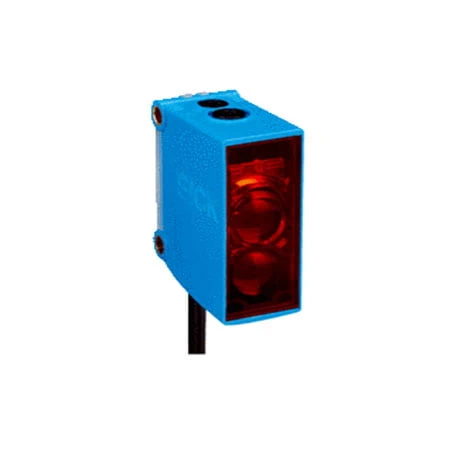
SICK 1065854 GTB10-P1211 PNP BGS Photoelectric Sensor

USD 93.08

GTB10-P1211 combines background suppression, PNP output, up to 950 mm reference-target range, 1,000 Hz switching and a 2 m cable in an IP67 housing.

SKU SICK-1065854 Category
SICK G10

SICK GTB10-P1211 PNP BGS Photoelectric Sensor

BrandSICK
Model IdentifierGTB10-P1211
Official Part Number1065854

Technical Overview

The SICK GTB10-P1211 is a background-suppression photoelectric sensor with a PNP switching output and a visible red PinPoint LED. Its maximum sensing range is 20–950 mm on a white reference target having 90% remission, with actual usable distance dependent on the target surface. The 625 nm LED produces an 8 mm light spot at 700 mm, and a five-turn potentiometer adjusts the sensing setting. Background suppression helps distinguish the intended target from more distant surfaces. Selectable light/dark switching, response of no more than 500 µs, 1,000 Hz operation, a 2 m cable and IP67 plastic housing support machine integration.

PNP background-suppression sensor with 950 mm maximum reference-target range, 1,000 Hz switching, 2 m cable and IP67 housing.

Key Features

  • Background suppression for target detection ahead of distant surfaces
  • 20–950 mm maximum range on 90% remission reference white
  • 625 nm visible red PinPoint LED
  • Ø 8 mm light spot at 700 mm
  • Five-turn sensing adjustment
  • PNP output; selectable light/dark switching
  • Response ≤ 500 µs; 1,000 Hz switching
  • 10–30 V DC; 20 mA current consumption
  • 2 m PVC cable with 0.14 mm² conductors
  • IP67 ABS/PMMA housing; −30 to +60 °C operation

Detect targets ahead of more distant machine surfaces with adjustable background suppression and a PNP switching output.

Technical Specification Matrix

ParameterValue
Functional principlePhotoelectric proximity sensor with background suppression
Maximum sensing range20–950 mm on 90% remission white target (DIN 5033)
Light sourcePinPoint LED, visible red light
Wavelength625 nm
Light spot sizeØ 8 mm at 700 mm
AdjustmentPotentiometer, 5 turns
Conductor cross-section0.14 mm²
Power supply10–30 V DC; short-circuit-protected network, max. 8 A
Residual ripple< 5 Vpp; remain within supply-voltage limits
Current consumption20 mA
Switching outputPNP
Switching modeLight/dark switching; selectable via selector
Output current≤ 100 mA
Response time≤ 500 µs with resistive load
Switching frequency1,000 Hz at light/dark ratio 1:1
Connection3-wire, 2 m PVC cable; do not bend below 0 °C
Circuit protectionSupply/input/output reverse-polarity protection, interference suppression and output overcurrent/short-circuit protection
Protection classIII
Housing formRectangular
Housing materialABS/PMMA plastic
IP ratingIP67
EMC standardEN 60947-5-2
Operating temperature−30 to +60 °C
Storage temperature−40 to +70 °C
UL fileNRKH.E348498 & NRKH7.E348498
Conditional standardUL325 when used with a sturdy protective hood, for example BEF-G10WSG (2071960)
MTTFD1,704 years
Diagnostic coverage DCavg0%
Dimensions L x W x H (cm)3.9 x 2 x 5
Physical Weight (kg)0.09

Industrial Applications

1. Workpiece detection in front of a machine frame

An assembly fixture must detect an opaque workpiece without responding to a structure farther behind it. Background suppression separates the intended near target from more distant surfaces within the documented operating geometry. The 20–950 mm maximum range on a 90% remission white target sensing range and five-turn adjustment support a defined detection position, while the PNP output supplies the workpiece signal to the controller.

Problem Solved

Distance-based background rejection reduces unwanted detections from the machine structure behind the fixture, giving the sequence controller a clearer indication that the intended workpiece occupies the sensing point.

Background suppression 20–950 mm maximum range on a 90% remission white target PNP

2. Counting separated components on a conveyor

A narrow conveyor carrying separated components needs a switching event at each passing part. The sensor directs a red spot of approximately 8 mm diameter at 700 mm toward the detection point. Background suppression helps distinguish the raised components from a more distant belt surface, and the 1,000 Hz switching frequency supports repeated transitions within the specified operating limits.

Problem Solved

A defined optical spot and background rejection help isolate component passages from the belt behind them, supporting repeatable count events without mechanical contact with the moving parts.

Ø 8 mm at 700 mm 1,000 Hz Background suppression

3. Checking tray seating before a handling cycle

A handling station can direct the sensor toward the expected edge of a seated opaque tray. The short sensing range establishes a local presence check, while background suppression limits responses from surfaces farther away when the tray is absent. The response of no more than 500 µs supplies a prompt input transition, and selectable light/dark switching fits the machine sequence logic.

Problem Solved

A contactless tray-position signal helps the controller distinguish an occupied pickup location from an empty station, supporting coordinated handling without a mechanical feeler at the tray edge.

≤ 500 µs Light/dark switching Short-range detection

Select your currency