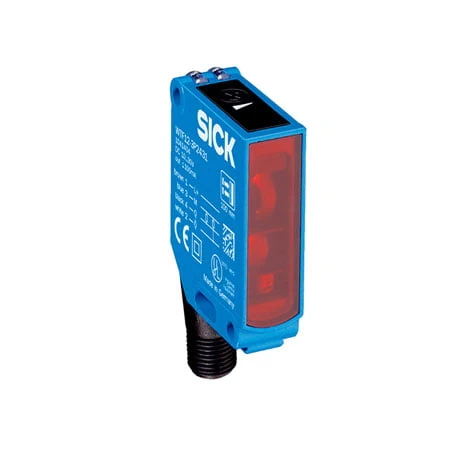
SICK 1041404 WTF12-3P2431 PNP Foreground-Suppression Sensor

USD 280.02

WTF12-3P2431 offers foreground suppression for flat objects, complementary PNP outputs, 30–175 mm sensing, 1,500 Hz switching and an M12 connector.

SKU SICK-1041404 Category
SICK W12-3

SICK WTF12-3P2431 PNP Foreground-Suppression Sensor

BrandSICK
Model IdentifierWTF12-3P2431
Official Part Number1041404

Technical Overview

The SICK WTF12-3P2431 is a photoelectric proximity sensor with foreground suppression and complementary PNP outputs. Its optical arrangement is suited to detecting flat objects in front of a stable background, with the receiving optics aligned to that background during setup. The specified sensing range is 30–175 mm, with the maximum range referenced to a white target having 90% remission. A 640 nm visible red LED forms a 2 mm spot at 60 mm, and a five-turn potentiometer sets the sensing condition. Response of no more than 330 µs, 1,500 Hz switching, an M12 connector and an IP66/IP67/IP69K metal housing support machine integration.

Foreground-suppression sensor for flat objects, with 30–175 mm sensing, complementary PNP outputs, five-turn adjustment and an M12 4-pin connector.

Key Features

  • Foreground-suppression photoelectric proximity sensing
  • Configured for detecting flat objects
  • 30–175 mm sensing range; maximum on 90% remission white reference
  • 640 nm visible red LED; Ø 2 mm spot at 60 mm
  • Five-turn potentiometer adjustment
  • Complementary PNP light/dark outputs
  • Response ≤ 330 µs; 1,500 Hz switching
  • M12 4-pin male connector; 10–30 V DC
  • Metal housing with PMMA front screen; IP66/IP67/IP69K
  • Two BEF-KH-W12 clamps with screws supplied

Detect flat objects against a stable background using foreground suppression and a 2 mm light spot at 60 mm.

Technical Specification Matrix

ParameterValue
Functional principlePhotoelectric proximity sensor with foreground suppression
Sensing range30–175 mm
Maximum sensing range30–175 mm on 90% remission white target (DIN 5033)
Light sourceLED, visible red light
Wavelength640 nm
Light spot sizeØ 2 mm at 60 mm
AdjustmentPotentiometer, 5 turns
Power supply10–30 V DC; short-circuit-protected network, max. 8 A
Residual ripple< 5 Vpp; remain within supply-voltage limits
Current consumption45 mA without load
Switching outputPNP, complementary
Switching modeLight/dark switching
Output current≤ 100 mA
Response time≤ 330 µs with resistive load
Switching frequency1,500 Hz at light/dark ratio 1:1
ConnectionMale connector M12, 4-pin
Circuit protectionSupply reverse-polarity protection, interference suppression, and output overcurrent/short-circuit protection
Protection classIII
Housing formRectangular
Housing materialMetal
Optics materialPMMA plastic front screen
IP ratingIP66, IP67 and IP69K
Operating temperature−40 to +60 °C
Storage temperature−40 to +75 °C
UL fileNRKH.E181493 and NRKH7.E181493
MTTFD810 years
Diagnostic coverage DCavg0%
Dimensions L x W x H (cm)4.2 x 1.56 x 4.85
Physical Weight (kg)0.12
PNP signal voltage HIGH/LOW> supply voltage − 2.5 V / approximately 0 V
Items supplied2 × BEF-KH-W12 clamps, including screws
Special applicationDetecting flat objects
Detection arrangementReceiver aligned to a stable background; foreground object changes the received-light state

Industrial Applications

1. Counting separated flat cards

A card feeder can aim the sensor at a stable conveyor background so each separated card passes through the optical path. Foreground suppression and the documented flat-object capability support this arrangement, while the 2 mm spot at 60 mm defines the monitored position. The complementary PNP outputs provide transitions for a machine counter.

Problem Solved

A local optical transition marks each separated card passage, allowing the controller to count flat material without a contact wheel or mechanical feeler on the card surface.

Flat objects Ø 2 mm at 60 mm PNP

2. Checking sheet-feed continuity

A sheet transport can align the receiving optics to a stable backing surface and monitor material travelling in front of it. A sheet changes the background reception state, while a gap caused by runout or a break restores the background signal. Foreground suppression and the five-turn adjustment establish the local detection condition.

Problem Solved

A change between sheet presence and exposed backing gives the controller an electrical indication of interrupted material feed, supporting a coordinated response at the transport section.

Foreground suppression Five-turn adjustment Sheet continuity

3. Confirming a flat insert in a fixture

An assembly station can place the sensor above a fixture with a stable background surface beneath the expected insert position. The foreground-suppression configuration detects the inserted flat part by the change in received background light. Complementary PNP outputs and response of no more than 330 µs provide the sequence controller with the local occupancy signal.

Problem Solved

A contactless insert signal helps the controller distinguish an occupied fixture from the exposed background before the next assembly movement begins at the station.

Flat insert Complementary PNP ≤ 330 µs

Select your currency