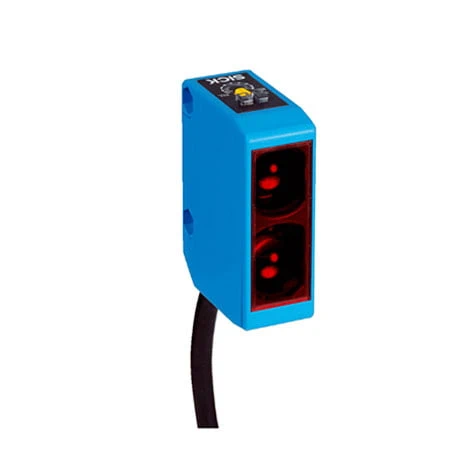
1. Workpiece detection in front of a machine frame
An assembly fixture must detect an opaque workpiece without responding to a structure farther behind it. Background suppression separates the intended near target from more distant surfaces within the documented operating geometry. The 150–500 mm sensing range on a 90% remission white target and two-turn adjustment with position indication support a defined detection position, while the isolated relay output supplies the workpiece signal to the controller.
Problem Solved
Distance-based background rejection reduces unwanted detections from the machine structure behind the fixture, giving the sequence controller a clearer indication that the intended workpiece occupies the sensing point.
Background suppression
150–500 mm
Relay
2. Counting separated components on a conveyor
A narrow conveyor carrying separated components needs a switching event at each passing part. The sensor directs a red spot of approximately 30 mm diameter at 500 mm toward the detection point. Background suppression helps distinguish the raised components from a more distant belt surface, and the 33 Hz switching frequency supports repeated transitions within the specified operating limits.
Problem Solved
A defined optical spot and background rejection help isolate component passages from the belt behind them, supporting repeatable count events without mechanical contact with the moving parts.
Ø 30 mm at 500 mm
33 Hz
Background suppression
3. Checking tray seating before a handling cycle
A handling station can direct the sensor toward the expected edge of a seated opaque tray. The short sensing range establishes a local presence check, while background suppression limits responses from surfaces farther away when the tray is absent. The response of no more than 15 ms supplies a prompt input transition, and the isolated relay provides a light-switching signal.
Problem Solved
A contactless tray-position signal helps the controller distinguish an occupied pickup location from an empty station, supporting coordinated handling without a mechanical feeler at the tray edge.
≤ 15 ms
Light switching
Short-range detection