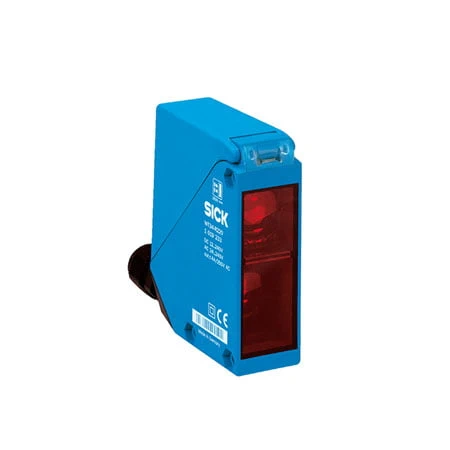
1. Monitoring sustained load accumulation
A conveyor transfer can direct the sensor toward opaque loads waiting at a discharge point. Background suppression limits responses from more distant structures, while the adjustable on-delay distinguishes sustained occupancy from a brief passage. The isolated change-over relay provides the resulting signal to compatible machine controls, with light or dark switching selected locally.
Problem Solved
A timed occupancy signal helps the controller identify loads remaining at the transfer position, supporting upstream feed coordination when downstream handling pauses during normal production.
On delay
0.5–10 s
Isolated relay
2. Counting separated loads on a conveyor
A conveyor can position the sensor so each separated opaque load passes nearer than the background belt or frame. The 40 mm at 1,200 mm light spot defines the monitored region, while background suppression helps distinguish the raised load from the farther surface. The 10 Hz switching frequency supports repeated transitions within the specified timing limits.
Problem Solved
Optical switching events identify separated load passages without contact, providing a count input while background rejection helps limit unwanted events from the surface behind the loads.
Background suppression
10 Hz
Separated loads
3. Confirming a tray at a pickup point
A handling station can direct the sensor toward the expected edge of a seated opaque tray. Background suppression limits responses from farther surfaces when the tray is absent, and the adjustable sensing condition establishes the local monitoring point. A response of no more than 10 ms and the switching output supply the controller with the occupancy transition.
Problem Solved
A local tray-position signal helps the controller coordinate the handling sequence and distinguish an occupied pickup location from an empty station without a contact switch at the moving edge.
Background suppression
Tray position
Contactless sensing