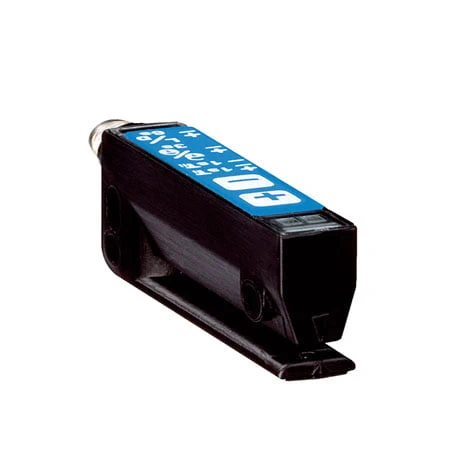
1. Registering labels for dispensing
A label dispenser can guide its web through the 3 mm fork and use each label-to-liner transition as a registration input. The infrared path evaluates optical contrast, while two-point or dynamic teach-in sets the threshold for the material. The stated 2 mm minimum label size and gap depend on label thickness.
Problem Solved
A transition signal identifies the label boundary for the machine controller, helping coordinate web stopping and dispensing after the actual label and liner contrast have been qualified.
Infrared
Teach-in
3 mm fork
2. Counting labels during roll preparation
A roll preparation station can pass the label web through the fork and count discrete changes between labels and their gaps. The NPN output provides switching events to compatible machine inputs. The 10 kHz switching frequency and response of no more than 50 µs define the available timing for separated transitions.
Problem Solved
Counting qualified label transitions gives the winding controller a quantity input for preparing rolls, allowing the machine sequence to compare the accumulated total with its target.
Label detection
NPN
10 kHz
3. Checking opaque strip continuity
A strip feeder can route material through the 3 mm fork opening so an intact strip normally blocks the infrared path. A break or runout restores received light and changes the selected light/dark output state. The M8 four-pin connection carries the signal to compatible controls, and IP65 protection supports machine mounting.
Problem Solved
A sustained change of optical state identifies missing material at the monitored point, allowing the controller to coordinate the feed sequence after detecting a strip break or runout.
Light/dark switching
M8 connector
Material continuity