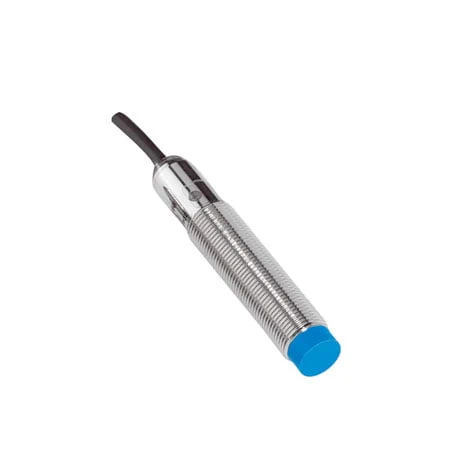
1. Confirming a metal part in a fixture
A machining fixture can place the sensor beside the expected location of a metal part so the target enters its assured sensing zone when seated. Non-flush installation requires the sensing end to project beyond the surrounding mounting surface, and the PNP normally open output provides the presence signal. Target material must be considered using the documented reduction factors.
Problem Solved
A contactless metal-presence signal helps the sequence controller identify an occupied fixture position before the next operation, avoiding a mechanical feeler pressing against the seated part.
Non-flush mounting
PNP NO
Metal presence
2. Counting metal tabs on a rotating mechanism
A rotating mechanism can present separated metal tabs to the M12 sensing face and count each normally open output transition. The 2,000 Hz switching frequency supports repeated passages within the documented limits. Tab geometry, spacing, operating gap and material reduction factors must be qualified so consecutive targets produce distinct switching events.
Problem Solved
Discrete tab passages provide the controller with a pulse count related to mechanism rotation, supporting cycle counting without an optical beam or contacting follower on the moving tabs.
2,000 Hz
Inductive
PNP NO
3. Confirming a shuttle at a transfer position
A shuttle can carry a metal flag that enters the sensor’s local detection zone at a transfer position. The M12 thread and two supplied mounting nuts support fixed installation, while the normally open PNP signal reports the flag state. IP67 protection and the nickel-plated brass body support exposed machine placement.
Problem Solved
A local position-confirmation signal helps the controller coordinate transfer sequencing when the metal flag reaches the monitored point, without a mechanical switch actuator following each shuttle movement.
M12 thread
IP67
Metal flag