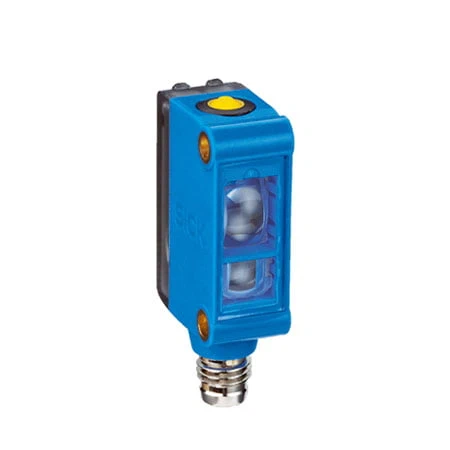
SICK 1062200 KTM-WN11181P RGB NPN Contrast Sensor

USD 210.86

KTM-WN11181P combines RGB illumination, static/dynamic teach-in, NPN output, 15 kHz switching and an M8 four-pin connector in an IP67 housing.

SKU SICK-1062200 Category
SICK KTM Prime

SICK KTM-WN11181P RGB NPN Contrast Sensor

BrandSICK
Model IdentifierKTM-WN11181P
Official Part Number1062200

Technical Overview

The SICK KTM-WN11181P is a compact RGB contrast sensor with an NPN switching output. Static or dynamic two-point teach-in learns the mark and background, automatically selects the emitted light and sets the contrast threshold; an additional adjustment can place the threshold closer to the mark. The sensor emits from the long housing side with a 1.6 × 9.5 mm spot, oriented vertically relative to that side. Its specified sensing distance is up to 12.5 mm with ±3 mm tolerance. Switching at 15 kHz, 32 µs response, a dynamic external teach input, M8 four-pin male connector and IP67 ABS housing support machine integration.

RGB contrast sensor with NPN output, static/dynamic teach-in, up to 12.5 mm sensing distance, 15 kHz switching and M8 four-pin male connector.

Key Features

  • RGB LED illumination at 470, 525 and 625 nm
  • Sensing distance ≤12.5 mm with ±3 mm tolerance
  • 1.6 × 9.5 mm spot, vertical to the long housing side
  • Light emission from the long device side
  • Static/dynamic two-point teach-in with mark-proximity adjustment
  • Automatic emitted-light selection; dynamic external teach input
  • NPN switching output; maximum total output current 50 mA
  • 15 kHz switching; 32 µs response and 15 µs jitter
  • 12–24 V DC supply; M8 four-pin male connector
  • IP67 ABS housing with PMMA optics; 20 g product weight

Teach the mark and background with automatic RGB light selection, then adapt the threshold toward the mark for the required contrast-detection condition.

Technical Specification Matrix

ParameterValue
Functional principleOptical contrast detection
Housing designSmall
Light sourceLED, RGB
Wavelengths470 nm, 525 nm and 625 nm
Light emissionLong side of housing
Light spot size1.6 × 9.5 mm
Light spot directionVertical relative to the long side of the housing
Receiving filterNone
Sensing distance≤12.5 mm; tolerance ±3 mm
AdjustmentTeach-in button
Teach-in modeStatic/dynamic two-point teach-in plus proximity to mark; ET input supports dynamic teach-in
Teach-in behaviorOptimum RGB emitted light selected automatically; threshold centered between mark and background
Mark-proximity adjustmentPress button again within 10 s after teaching, for >20 ms and <10 s, to place threshold at 75% from background (0%) toward mark (100%)
Switching modeLight/dark switching; static teach sequence defines logic; dynamic output active on mark when background occupied the field longer during teaching
Key lockActivate/deactivate by holding teach-in button for >30 s
IndicatorsGreen LED: power on; yellow LED: switching-output indication; rapid flashing of yellow LED and emitted light indicates teach-in failure
Power supply12–24 V DC; limit values 12 V −10% to 24 V +20%; short-circuit-protected network max. 8 A
Residual ripple≤5 Vpp; remain within supply tolerances
Current consumption<50 mA without load
Switching frequency15 kHz at light/dark ratio 1:1
Response time32 µs
Jitter15 µs
Switching outputNPN
Output current50 mA maximum, total of all outputs
Dynamic teach inputNPN teach: U<2 V; run: supply minus 2 V or open
Retention time ET28 ms; non-volatile memory
Time delayNone
ConnectionM8 four-pin male connector
Pin assignment1/BN: L+; 2/WH: ET; 3/BU: M; 4/BK: Q
Protection classIII
Circuit protectionSupply reverse-polarity protection, output Q short-circuit protection and interference-pulse suppression
Housing materialABS plastic
Optics materialPMMA plastic
IP ratingIP67
Operating temperature−10 to +55 °C
Storage temperature−20 to +75 °C
Shock resistanceAccording to IEC 60068
UL fileNRKH.E348498 and NRKH7.E348498
NPN output voltageHIGH approximately supply voltage; LOW ≤2 V
Dimensions L x W x H (cm)2.1 x 1.2 x 3.15
Physical Weight (kg)0.02

Industrial Applications

1. Registering a printed packaging web

A packaging web can carry a contrasting registration mark past the sensor at the specified sensing distance. Static or dynamic two-point teach-in sets the mark and background conditions, after which each qualified optical transition provides a switching event. The 15 kHz switching frequency and 32 µs response define timing limits for the machine controller to evaluate during commissioning.

Problem Solved

A qualified print-mark event gives the controller a repeatable optical reference for web positioning, helping coordinate the feed cycle with printed artwork after actual material contrast has been tested.

Print registration 15 kHz Contrast sensing

2. Checking a printed label at an inspection point

A label-handling station can direct the light spot at a designated printed patch while the label is held in a controlled position. Static or dynamic two-point teach-in sets the mark and background conditions. A compatible controller reads the NPN switching signal to distinguish the qualified printed patch from the exposed background at that local inspection point.

Problem Solved

A local contrast check identifies whether the expected printed patch is present at the inspection point, allowing the controller to flag missing or misplaced labels without mechanical contact.

Label inspection NPN Printed patch

3. Indexing contrasting sections on a rotary carrier

A rotary carrier can present alternating light and dark reference patches to the sensor while keeping the surface within the specified sensing distance. Each qualified transition changes the NPN output for the local control input. The documented response time limits detection latency, and the IP67 housing supports installation near the machine mechanism.

Problem Solved

Contrasting reference patches provide discrete angular indexing events for a compatible controller, helping identify expected carrier positions without a contact cam switch at the monitored surface.

Rotary indexing NPN IP67

Select your currency