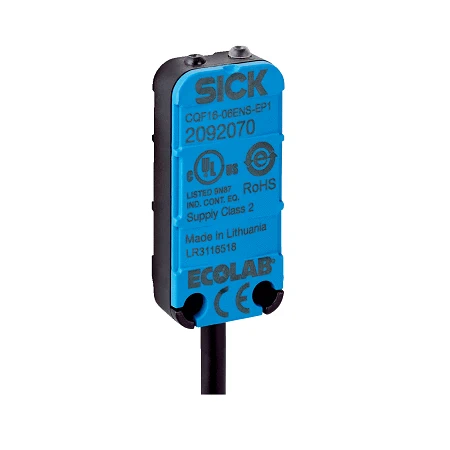
SICK 6068624 CQF16-06EPSEP1 PNP NO Capacitive Liquid Sensor

USD 151.84

CQF16-06EPSEP1 detects water-based liquids through qualified nonmetal walls with a PNP NO output, full/empty teach-in and IP67/IP68/IP69K protection.

SKU SICK-6068624 Category
SICK CQF

SICK CQF16-06EPSEP1 PNP NO Capacitive Liquid Sensor

BrandSICK
Model IdentifierCQF16-06EPSEP1
Official Part Number6068624

Technical Overview

The SICK CQF16-06EPSEP1 is a capacitive point-level sensor for water-based liquids with conductivity up to 50 mS/cm. It detects liquid through qualified nonmetal container walls and compensates for foam, moisture and deposits. The specified wall ranges are 0.5–6 mm for plastic and 0.5–4 mm for glass, with a minimum container diameter of 8 mm. A PNP normally open output supplies the discrete level signal, while full or empty teach-in uses the external wire. The sensor offers 10 Hz switching, 10–30 V DC operation, a 0.3 m PVC cable with M8 four-pin male connector and an IP67/IP68/IP69K PBT housing with a supplied mounting bracket.

Capacitive water-based liquid sensor with PNP NO output, external full/empty teach-in, 0.3 m PVC cable with M8 four-pin male connector, IP67/IP68/IP69K protection and mounting bracket.

Key Features

  • Capacitive point-level detection of water-based liquids
  • Liquid conductivity up to 50 mS/cm
  • Compensation for foam, moisture and deposits
  • Plastic walls 0.5–6 mm; glass walls 0.5–4 mm; container diameter ≥8 mm
  • PNP normally open output; maximum output current 100 mA
  • Full or empty teach-in via external wire/pin
  • 10 Hz switching; 10–30 V DC operation
  • 0.3 m pvc cable with m8 four-pin male connector
  • IP67/IP68/IP69K PBT housing; −25 to +80 °C operation
  • BEF-WMCQF16 bracket included; green supply and yellow output LEDs

Detect water-based liquid through a suitable plastic or glass wall while compensating for foam, moisture and deposits at the monitored point.

Technical Specification Matrix

ParameterValue
Functional principleCapacitive point-level detection of water-based liquids
Liquid conductivityUp to 50 mS/cm
Media compensationCompensates for foam, moisture and deposits
Sensing range0.5–6 mm; reference range depends on target electrical properties and density
Container wall thicknessPlastic 0.5–6 mm; glass 0.5–4 mm
Minimum container diameter8 mm
InstallationFlush or non-flush
Switching outputPNP
Output functionNormally open (NO)
Electrical wiringDC, 4-wire
Switching frequency10 Hz
AdjustmentFull or empty teach-in via external wire/pin
Teach-in timingConnect ET/white wire to L+: >2 to <7 s for full; >7 to <12 s for empty; >14 s cancels calibration
Teach input when unusedManufacturer recommends permanent connection to V− when not used for calibration
Power supply10–30 V DC; Class 2 supply for UL approval
Residual ripple≤10%
Voltage drop≤1.5 V DC at maximum output current
Current consumption13 mA without load
Initialization time≤300 ms
Output current≤100 mA
Temperature drift±20% of sensing range
Short-circuit protectionYes
Power-up pulse suppressionYes
Connection0.3 m pvc cable with m8 four-pin male connector
Pin / wire assignment1/BN: L+; 2/WH: Teach; 3/BU: M; 4/BK: Q
Cable materialPVC; do not bend below 0 °C
Conductor cross-section0.14 mm²
Housing materialPBT plastic
Housing designRectangular
IP ratingIP67, IP68 and IP69K
Maximum tightening torque0.2 Nm
Protection classIII
IndicatorsYellow: switching output; green: supply voltage
Items suppliedOne BEF-WMCQF16 mounting bracket
Operating temperature−25 to +80 °C
Storage temperature−40 to +85 °C
Shock and vibration resistance30 g for 11 ms, six positive and six negative shocks per axis; 10–150 Hz, 1.0 mm / 15 g
EMCEN 60947-5-2
MTTFD1,972 years
Diagnostic coverage DCavg0%
Mission time20 years
UL fileNRKH.E191603
Mounting bracket size73.9 mm length × 26 mm width; supplied bracket is separate from sensor housing dimensions
Dimensions L x W x H (cm)0.8 x 1.6 x 3.4

Industrial Applications

1. Requesting replenishment of a water-based adhesive reservoir

A carton-gluing station can mount the sensor outside a plastic adhesive reservoir at its replenishment point. The water-based adhesive must stay within the specified conductivity limit and wall thickness range. Full or empty teach-in adapts the threshold, and the PNP NO output gives the controller a discrete indication as the adhesive surface passes the monitored height.

Problem Solved

The low-level event gives the packaging controller a replenishment cue before the monitored adhesive reserve is exhausted, helping coordinate refilling without a probe inside the reservoir.

Adhesive reserve External teach-in PNP NO

2. Starting a condensate collection drain cycle

A condensate collection vessel can place the sensor at the level where a drain cycle should begin. Through-wall capacitive detection monitors water-based liquid without opening the nonmetal vessel. The controller reads the PNP NO output and applies its drain sequence, while full or empty teaching accounts for the actual wall and expected moisture or deposits.

Problem Solved

A high-level event gives the controller a defined trigger for condensate removal, reducing dependence on timed draining when the rate of liquid accumulation varies during machine operation.

Condensate collection Drain trigger Media compensation

3. Checking liquid arrival in a nonmetal transfer pipe

A transfer system can fasten the supplied bracket beside a suitable plastic or glass pipe and teach the sensor for the actual water-based liquid. The pipe diameter and wall thickness must meet the documented limits. The PNP NO switching event identifies local liquid presence during a priming sequence, with 10 Hz switching defining the event-rate limit.

Problem Solved

A local liquid-arrival event gives the controller a reference during line priming, helping distinguish a filled monitored pipe section from an empty section without a wetted contact probe.

Pipe priming Local liquid arrival 10 Hz

Select your currency