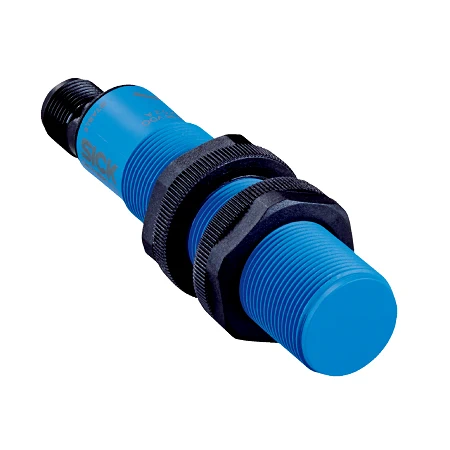
SICK 6058145 CM18-08BPP-EC1 PNP Capacitive Sensor

USD 159.64

CM18-08BPP-EC1 provides complementary PNP capacitive sensing, 0–8 mm flush range, 50 Hz switching, 11-turn adjustment and IP67/IP68/IP69K protection.

SKU SICK-6058145 Category
SICK CM

SICK CM18-08BPP-EC1 PNP Capacitive Sensor

BrandSICK
Model IdentifierCM18-08BPP-EC1
Official Part Number6058145

Technical Overview

The SICK CM18-08BPP-EC1 is a capacitive proximity sensor with an M18 × 1 threaded housing and complementary PNP output. It detects nearby material by evaluating changes in capacitance, supporting qualified metal and nonmetal targets. Its specified range is 0–8 mm flush, with actual reach dependent on material and installation. The 11-turn sensitivity potentiometer adapts sensitivity to the target and surroundings. The sensor operates from 10–36 V DC at 50 Hz and connects through an M12 four-pin male connector. Its plastic housing provides IP67/IP68/IP69K protection, and two PA12 mounting nuts are included. Material reduction factors guide commissioning.

M18 × 1 capacitive sensor with complementary PNP output, 0–8 mm flush range, 11-turn sensitivity potentiometer, 50 Hz switching and M12 four-pin male connector.

Key Features

  • Capacitive proximity sensing for qualified metal and nonmetal targets
  • M18 × 1 threaded housing
  • 0–8 mm flush specified sensing range
  • Complementary npn output
  • 11-turn sensitivity potentiometer
  • 10–36 V DC operating supply; 50 Hz switching
  • M12 four-pin male connector
  • IP67/IP68/IP69K protection; IP68 test: 1 m water depth for 60 min
  • Material-dependent range; manufacturer reference reduction factors available
  • Two PA12 plastic mounting nuts included; adjustment screwdriver supplied

Adjust capacitive detection for qualified metal or nonmetal targets and provide a discrete complementary PNP signal through an M18 × 1 threaded sensor.

Technical Specification Matrix

ParameterValue
Functional principleCapacitive proximity sensing
Housing designMetric threaded housing
Thread sizeM18 × 1
Housing diameter18 mm
Sensing range0–8 mm flush
Assured sensing distance6.12 mm; for flush mounting in electrically conductive material at <0 °C or >60 °C, Sa = 0.8 × Sr
InstallationFlush
Switching outputComplementary npn
Output functionComplementary NO and NC
Output characteristicWire configurable
Electrical wiringDC, 4-wire
Adjustment11-turn sensitivity potentiometer
Switching frequency50 Hz
Material reduction factorsReference values, material dependent: metal 1; water 1; PVC approximately 0.4; oil approximately 0.25; glass 0.6; ceramics 0.5; alcohol 0.7; wood 0.2–0.7
Power supply10–36 V DC
Residual ripple≤10% of supply voltage
Voltage drop≤2.5 V DC at maximum output current
Current consumption12 mA without load
Initialization time≤200 ms
Hysteresis3–20% of sensing range
Reproducibility≤5% of sensing range at constant supply voltage and ambient temperature
Output current≤200 mA
Short-circuit protectionYes
Power-up pulse suppressionYes
ConnectionM12 four-pin male connector
Housing materialPBT plastic
IP ratingIP67/IP68/IP69K
IP68 test condition1 m water depth for 60 min
Operating temperature−30 to +85 °C; sensor front briefly +120 °C per manufacturer footnote
Storage temperature−40 to +85 °C
Maximum tightening torque≤2.6 Nm
Items suppliedTwo PA12 plastic mounting nuts and one potentiometer screwdriver
MTTFD919 years
Diagnostic coverage DCavg0%
Mission time20 years
UL fileNRKH.E191603
Temperature drift±10% of sensing range
Overall rigid length85 mm including M12 connector
Housing body length70 mm as dimensioned in manufacturer drawing
Thread length55 mm
IndicatorsYellow switching/status LED; green operating LED
Pin / wire assignment1/BN: L+; 4/BK: NO; 2/WH: NC; 3/BU: M
Shock resistanceIEC 60068-2-27: 30 g for 11 ms, three positive and three negative shocks per axis
Rough-handling shock testsIEC 60068-2-31: twice from 1 m; 100 times from 0.5 m
Vibration resistanceIEC 60068-2-6: 10–150 Hz, 1 mm / 15 g
EMCEN 60947-5-2
Electrostatic-discharge testEN 61000-4-2: contact and air discharge >40 kV
Fast-transient / burst testEN 61000-4-4: ±4 kV
Surge testEN 61000-4-5: supply and output >2 kV with 500 Ω
Conducted-disturbance testEN 61000-4-6: >20 Vrms
Power-frequency magnetic-field testEN 61000-4-8: continuous >60 A/m (75.9 µT); short-time >600 A/m (759 µT)
Radiated RF testEN 61000-4-3: >20 V/m

Industrial Applications

1. Checking a nonmetal part in an assembly fixture

An assembly fixture can place a qualified nonmetal part near the sensing face and use the complementary PNP signal to confirm its local presence. The 11-turn sensitivity potentiometer adapts sensitivity to the actual target and surrounding fixture. Commissioning compares empty and occupied states at the installed spacing, taking the documented material reduction factors into account.

Problem Solved

A local presence signal helps the controller detect a missing part before the next assembly step, without requiring a metal target on the component or a contact actuator.

Part presence Nonmetal targets Capacitive sensing

2. Detecting a liquid at a point in a nonmetal vessel

A suitable nonmetal vessel can position the sensor outside its wall at the desired detection point. After testing the actual wall, liquid and spacing, the 11-turn sensitivity potentiometer sets a threshold between empty and filled conditions. The complementary PNP output provides a discrete point-level event to a compatible controller; the specified range remains subject to the installed materials.

Problem Solved

A qualified external point-level signal helps the process controller identify liquid reaching the monitored height while avoiding a probe inside the vessel and preserving the vessel wall.

Point level External mounting Qualified vessel wall

3. Monitoring granulate at a feed inspection window

A granulate feeder can place the sensor beside a suitable nonmetal inspection window to check whether material occupies the monitored location. The 11-turn sensitivity potentiometer is set using the actual granulate, window and installation spacing. Empty and filled tests, including expected moisture and buildup conditions, qualify the discrete output before it is used to coordinate feeding.

Problem Solved

A local material-presence event helps the controller identify an empty feed location or arrival of replenishment material, supporting feed sequencing without placing a mechanical paddle in the granulate.

Granulate feed Material presence Threshold setup

Select your currency