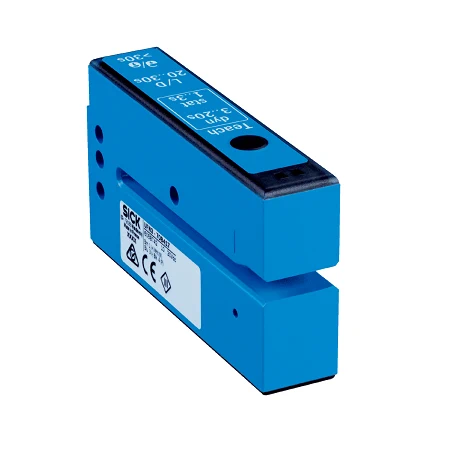
1. Registering the label feed before dispensing
A label applicator can pass its carrier web through the fork and use the label-to-gap transition as a feed reference before the peel point. Teaching learns the carrier and label condition for that stock. The 3 mm opening, 69 mm fork depth and material-dependent 2 mm minimum label/gap specification define the mechanical and target limits.
Problem Solved
A detected label edge gives the feed controller a reference for stopping and advancing the web, helping align each dispensing cycle with the next label on its carrier.
Label-feed registration
3 mm opening
NPN
2. Counting labels during a roll transfer
A roll-transfer machine can use one qualified NPN transition per label as an input to its external counter while the web passes through the fork. Teaching distinguishes the label from the exposed carrier. The typical 1.5 kHz switching frequency depends on material and speed, and the controller evaluates the actual label pitch before selecting its operating speed.
Problem Solved
Counting qualified label transitions gives the roll-transfer controller a quantity reference for batch completion and inventory reconciliation, avoiding manual counting of labels already wound onto the destination roll.
Roll quantity
Typical 1.5 kHz
NPN counter input
3. Flagging a missing label position on a moving web
A web-inspection station can compare label/gap events from the sensor with the machine encoder’s expected pitch windows. If a taught label event is absent in a scheduled window, the external controller can flag that position before it reaches the applicator. Thickness-dependent minimum label and gap sizes and the sensor response limit the usable stock and speed.
Problem Solved
Comparing a scheduled label window with the ultrasonic event identifies an empty carrier position, allowing the machine controller to mark or reject a missed-label cycle before dispensing.
Missing-label check
Teach-in
≤250 µs