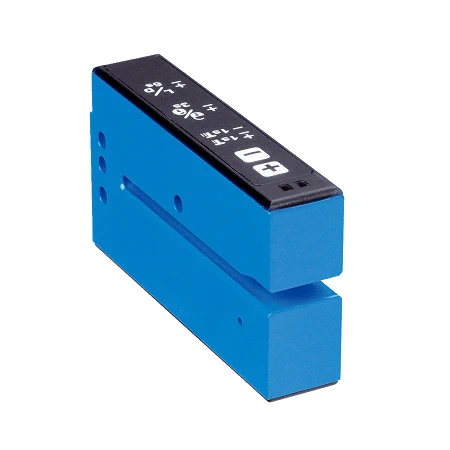
SICK 6049680 UFN3-70N415 NPN Ultrasonic Fork Sensor

USD 736.06

Ultrasonic label detection with a 3 mm opening, 69 mm fork depth, NPN output, plus/minus adjustment, two-point/dynamic teaching and M8 connection.

SKU SICK-6049680 Category
SICK UF

SICK UFN3-70N415 NPN Ultrasonic Label Fork Sensor

BrandSICK
Model IdentifierUFN3-70N415
Official Part Number6049680

Technical Overview

The SICK UFN3-70N415 is an ultrasonic fork sensor for label and carrier-gap detection with an NPN switching output. Its 3 mm fork opening and 69 mm fork depth support installation around a guided web. The specified minimum label size and gap are 2 mm, depending on label thickness. Two-point and dynamic teaching, plus/minus sensitivity adjustment and light/dark switching adapt detection to the material. Typical switching frequency is 1.5 kHz depending on material and speed, with response no greater than 250 µs. An M8 four-pin male connector, 10–30 V DC supply and IP65 aluminum housing support machine integration.

NPN ultrasonic label fork sensor with 3 mm opening, 69 mm fork depth, thickness-dependent 2 mm label/gap detection and M8 four-pin male connector.

Key Features

  • Ultrasonic label and carrier-gap detection
  • 3 mm fork opening and 69 mm fork depth
  • Minimum label size/gap 2 mm, depending on label thickness
  • Two-point and dynamic teach-in
  • Plus/minus controls for teaching, sensitivity and light/dark switching; cable adjustment supported
  • NPN output, maximum 100 mA and minimum 0.3 mA
  • Typical 1.5 kHz switching, material/speed dependent; response ≤250 µs
  • 100 ms initialization; 10–30 V DC supply
  • M8 four-pin male connector; pin 2 teach and pin 4 Q
  • IP65 aluminum housing; +5 to +55 °C operation

Teach the ultrasonic distinction between carrier and label, then adjust sensitivity with plus/minus controls and provide an NPN machine signal.

Technical Specification Matrix

ParameterValue
Functional principleUltrasonic detection
Housing designFork shaped
Label detectionYes
Fork opening3 mm
Fork depth69 mm
Minimum detectable objectLabel gap / label size: 2 mm, depending on label thickness
AdjustmentPlus/minus buttons for teach-in, sensitivity and light/dark switching; cable adjustment supported
Teach-in modeTwo-point and dynamic teach-in
Switching modeLight/dark switching
IndicatorsYellow switching-output indicator and red function indicator
Power supply10–30 V DC; reverse-polarity protected; short-circuit-protected network max. 8 A
Residual ripple<10%, within supply tolerances
Current consumption40 mA without load
Initialization time100 ms
Switching frequency1.5 kHz typical at 1:1 light/dark ratio; depends on material and speed
Response time≤250 µs
Switching outputNPN
Output current100 mA maximum; 0.3 mA minimum
Teach inputTeach: 7 V<U<supply voltage; run: U<2 V
Protection classIII; reference voltage DC 50 V
Circuit protectionOutput Q short-circuit protection and interference-pulse suppression
ConnectionM8 four-pin male connector
Pin assignment1/BN: L+; 2/WH: teach; 3/BU: M; 4/BK: Q
Housing materialAluminum
Mounting holesØ4.2 mm
IP ratingIP65
Operating temperature+5 to +55 °C
Storage temperature−20 to +70 °C
Shock resistanceAccording to EN 60068-2-27
EMCEN 60947-5-2; industrial Class A
MTTFD207 years
Diagnostic coverage DCavg0%
UL fileNRKH.E191603 and NRKH7.E191603
NPN output voltageHIGH approximately supply voltage; LOW ≤2 V
Dimensions L x W x H (cm)9.25 x 1.8 x 4.75
Physical Weight (kg)0.095

Industrial Applications

1. Registering the label feed before dispensing

A label applicator can pass its carrier web through the fork and use the label-to-gap transition as a feed reference before the peel point. Teaching learns the carrier and label condition for that stock. The 3 mm opening, 69 mm fork depth and material-dependent 2 mm minimum label/gap specification define the mechanical and target limits.

Problem Solved

A detected label edge gives the feed controller a reference for stopping and advancing the web, helping align each dispensing cycle with the next label on its carrier.

Label-feed registration 3 mm opening NPN

2. Counting labels during a roll transfer

A roll-transfer machine can use one qualified NPN transition per label as an input to its external counter while the web passes through the fork. Teaching distinguishes the label from the exposed carrier. The typical 1.5 kHz switching frequency depends on material and speed, and the controller evaluates the actual label pitch before selecting its operating speed.

Problem Solved

Counting qualified label transitions gives the roll-transfer controller a quantity reference for batch completion and inventory reconciliation, avoiding manual counting of labels already wound onto the destination roll.

Roll quantity Typical 1.5 kHz NPN counter input

3. Flagging a missing label position on a moving web

A web-inspection station can compare label/gap events from the sensor with the machine encoder’s expected pitch windows. If a taught label event is absent in a scheduled window, the external controller can flag that position before it reaches the applicator. Thickness-dependent minimum label and gap sizes and the sensor response limit the usable stock and speed.

Problem Solved

Comparing a scheduled label window with the ultrasonic event identifies an empty carrier position, allowing the machine controller to mark or reject a missed-label cycle before dispensing.

Missing-label check Teach-in ≤250 µs

Select your currency