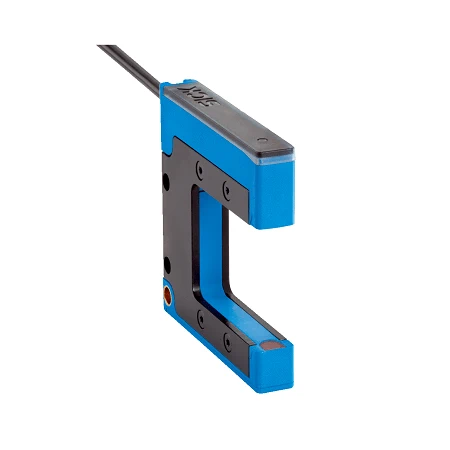
SICK 1106552 WFE-030040B121 Push-Pull Optical Fork Sensor

USD 74.10

Red-light fork detection with a 30 mm opening, 0.5 mm minimum object size, push-pull dark-switching output, 5 kHz operation and a 2 m three-wire cable.

SKU SICK-1106552 Category
SICK WFE

SICK WFE-030040B121 Push-Pull Optical Fork Sensor

BrandSICK
Model IdentifierWFE-030040B121
Official Part Number1106552

Technical Overview

The SICK WFE-030040B121 is a visible-red-LED fork sensor with a push-pull PNP/NPN dark-switching output. Its opposed optical path spans a 30 mm fork opening, and the minimum detectable object is specified as 0.5 mm. This version offers no adjustment, providing a fixed detection configuration for targets passing through the fork. A 5 kHz switching frequency, response no greater than 100 µs and response-time stability of ±20 µs define its timing characteristics. The sensor operates from 10–30 V DC through a 2 m open-ended three-wire cable. An IP67 ABS housing with a coated carbon-steel frame supports machine installation.

Red-LED optical fork sensor with 30 mm opening, 0.5 mm minimum object, fixed push-pull dark switching, 5 kHz operation and 2 m three-wire cable.

Key Features

  • Visible red LED optical fork detection
  • 30 mm fork opening; minimum detectable object 0.5 mm
  • Fixed detection setting with no adjustment possibility
  • Push-pull PNP/NPN output; dark switching
  • 5 kHz switching and response ≤100 µs
  • Response-time stability ±20 µs; output hysteresis <0.1 mm
  • 10–30 V DC operation; <30 mA no-load consumption
  • 2 m open-ended three-wire cable, Ø4 mm
  • IP67 ABS housing with coated carbon-steel frame
  • Green power and yellow switching LEDs; −20 to +60 °C operation

Detect targets crossing a 30 mm optical fork with fixed dark switching and a push-pull signal, without a sensitivity-adjustment step.

Technical Specification Matrix

ParameterValue
Functional principleVisible-red-LED optical fork detection
Fork opening30 mm
Minimum detectable object0.5 mm
Light sourceLED, visible red light
AdjustmentNo adjustment possibility
IndicatorsGreen LED: power on; yellow LED: switching-output state
Power supply10–30 V DC
Residual ripple<10%
Current consumption<30 mA without load
Initialization time100 ms
Switching frequency5 kHz
Response time≤100 µs
Response-time stability±20 µs
Switching outputPush-pull PNP/NPN
Output voltageHIGH: voltage drop <2 V from supply; LOW ≤2 V
Switching modeDark switching
Switching hysteresis<0.1 mm
Output current100 mA maximum
Protection classIII
Circuit protectionSupply reverse-polarity protection, output Q short-circuit protection and interference-pulse suppression
Connection2 m open-ended three-wire cable; diameter 4 mm
Wire assignmentBN: L+; BU: M; BK: Q
Housing materialABS; coated carbon steel frame
Mounting holesØ4.3 mm
IP ratingIP67
Operating temperature−20 to +60 °C
Storage temperature−40 to +75 °C
Ambient light immunity≤10,000 lx
Shock resistanceIEC 60068-2-27; 30 g for 11 ms
MTTFD1,217 years
Diagnostic coverage DCavg0%
Mission time20 years
UL fileNRKH.E348498 and NRKH7.E348498
Dimensions L x W x H (cm)6.05 x 1 x 5.93

Industrial Applications

1. Counting parts leaving a guided feeder

A guided feeder can carry individual parts through the fork so each opaque target interrupts the red-light path. The fixed dark-switching output supplies a pulse to an external counter. Targets must meet the 0.5 mm minimum detectable-object specification, and the 5 kHz switching frequency and response limit define the timing available between successive parts.

Problem Solved

A qualified beam-interruption event gives the external counter a part-passage reference, supporting quantity tracking at the feeder exit without a mechanical counting lever touching the components.

Part counting 0.5 mm MDO 5 kHz

2. Indexing a carrier with an opaque flag

A moving carrier can carry an opaque reference flag through the 30 mm fork opening at a designated station. The dark-switching push-pull output changes when the flag crosses the optical axis. The fixed setting and sub-0.1 mm output hysteresis provide specified switching behavior for a controller using the event as a discrete reference.

Problem Solved

The flag provides a discrete carrier-position event for the machine controller, helping coordinate a station cycle without a contact cam or adjustable sensitivity setting at that reference point.

Carrier indexing 30 mm opening Push-pull

3. Checking a component at an assembly fixture

An assembly fixture can position the fork so a seated component interrupts the light path at the inspection point. A component that leaves the path clear produces the opposite switching condition. The external controller reads that condition before advancing the assembly sequence, using the 0.5 mm minimum detectable object and fixed dark-switching configuration as selection limits.

Problem Solved

A local beam-state check distinguishes the qualified seated-component condition from an empty fixture at the monitored point, allowing the controller to flag a missing-part condition before the next operation.

Fixture presence Dark switching No adjustment

Select your currency