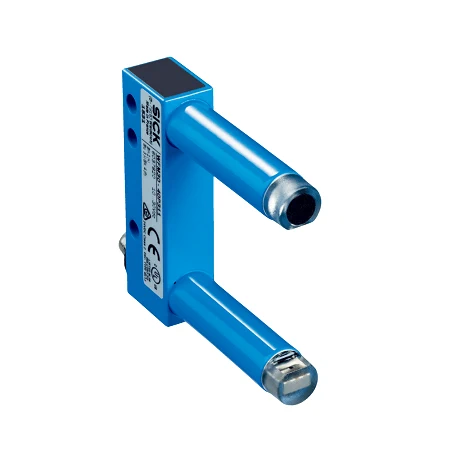
1. Counting parts leaving a guided feeder
A guided feeder can carry individual parts through the fork so each opaque target interrupts the red-light path. The fixed dark-switching output supplies a pulse to an external counter. Targets must meet the 0.8 mm minimum detectable-object specification, and the 4 kHz switching frequency and response limit define the timing available between successive parts.
Problem Solved
A qualified beam-interruption event gives the external counter a part-passage reference, supporting quantity tracking at the feeder exit without a mechanical counting lever touching the components.
Part counting
0.8 mm MDO
4 kHz
2. Indexing a carrier with an opaque flag
A moving carrier can carry an opaque reference flag through the 30 mm fork opening at a designated station. The PNP output changes when the flag crosses the optical axis. The fixed setting and response no greater than 125 µs define switching behavior for an external controller using one configured edge as a discrete position reference.
Problem Solved
The flag provides a discrete carrier-position event for the machine controller, helping coordinate a station cycle without a contact cam or adjustable sensitivity setting at that reference point.
Carrier indexing
30 mm opening
PNP
3. Checking a component at an assembly fixture
An assembly fixture can position the fork so a seated component interrupts the light path at the inspection point. A component that leaves the path clear produces the opposite switching condition. The external controller reads that condition before advancing the assembly sequence, using the 0.8 mm minimum detectable object and fixed dark-switching configuration as selection limits.
Problem Solved
A local beam-state check distinguishes the qualified seated-component condition from an empty fixture at the monitored point, allowing the controller to flag a missing-part condition before the next operation.
Fixture presence
Dark switching
No adjustment