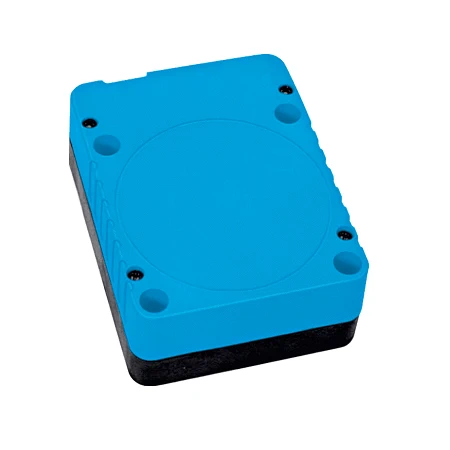
SICK 7900227 IQ80-60NPP-KK0 Inductive Sensor

USD 200.72

Rectangular inductive sensor with 60 mm nominal range, wire-configurable PNP NO/NC, M20 gland, 100 Hz switching and IP65 protection.

SKU SICK-7900227 Category
SICK IQL

SICK IQ80-60NPP-KK0 Inductive Proximity Sensor

BrandSICK
Model IdentifierIQ80-60NPP-KK0
Official Part Number7900227

Technical Overview

The SICK IQ80-60NPP-KK0 is a rectangular inductive proximity sensor with a 60 mm nominal range for detecting metal targets without contact. It provides a wire-configurable PNP NO or NC output, with a switching frequency of 100 Hz. This non-flush version uses terminal connection through an M20 gland, with a PPE plastic housing and sensing face rated IP65. A 10–36 V DC supply and output current up to 250 mA support connection to compatible machine controls. Target material reduction factors and the manufacturer mounting clearances determine the final detection arrangement.

Rectangular 60 mm inductive metal sensor with a wire-configurable PNP NO or NC output, 100 Hz switching and M20-gland terminal connection.

Key Features

  • 60 mm nominal inductive metal-detection range
  • Non-flush installation; 48.6 mm assured sensing range
  • PNP NO/NC output; wire-configurable DC three-wire
  • 100 Hz switching frequency
  • 10–36 V DC; continuous output current ≤250 mA
  • Terminal connection with M20 gland; conductors ≤2.5 mm²
  • PPE plastic housing and sensing face
  • IP65 per EN 60529
  • −25 to +80 °C operation
  • Short-circuit and power-up pulse protection

Detect metal machine targets at a 60 mm nominal distance with a wire-configurable PNP NO or NC signal.

Technical Specification Matrix

ParameterValue
Functional principleInductive metal proximity detection
Housing formRectangular, standard design
Sensing range Sn60 mm nominal
InstallationNon-flush
Switching frequency100 Hz
Output configurationPNP, NO or NC, wire-configurable
Electrical wiringDC three-wire
ConnectionTerminal connection with M20 gland
Connection diagramCD-024; NO/NC selected by terminal wiring
Power supply10–36 V DC
Voltage drop≤2.5 V at maximum output current and 24 V supply
Hysteresis1–15%
Temperature drift±10% of Sr
EMCAccording to EN 60947-5-2
Operating temperature−25 to +80 °C
Housing materialPPE plastic
Sensing face materialPPE plastic
Shock resistance30 g, 11 ms
Vibration resistance10–55 Hz, 1 mm
IP ratingIP65 per EN 60529
MTTFD2,043 years
Diagnostic coverage DCavg0%
Mission time20 years
Target-material reduction factorsApproximate reference values, may vary: V2A/304=0.7; aluminum=0.3; copper=0.2; brass=0.4
Mounting clearancesA=160 mm; B=160 mm; C=80 mm; D=150 mm; E=40 mm; F=480 mm; follow exact installation diagram
Assured sensing range Sa48.6 mm
Wire size≤2.5 mm²
Adjustment hardwarePotentiometer and display LED shown in exact drawing
Mounting hole pitch65 ×65 mm
Mounting holesØ5.5 mm
Continuous output current≤250 mA
Off-state current≤0.5 mA
Circuit protectionShort-circuit and power-up pulse protection

Industrial Applications

1. Confirming a metal pallet at a transfer stop

A transfer stop can position a qualified metal pallet feature in front of the sensing face. The 60 mm nominal range permits a detection gap subject to target material and the required installation clearances. The external controller evaluates the selected output state as a local pallet-position reference before it advances the transfer sequence.

Problem Solved

A noncontact arrival signal provides the transfer controller with a pallet-position input, avoiding a mechanical lever contacting the pallet during repeated station-to-station handling cycles.

Pallet position 60 mm nominal Inductive

2. Checking a metal assembly at a fixture

An assembly fixture can bring an intended metal component into the sensor detection zone at a defined inspection point. The output reports the local presence condition, while the documented material reduction factors guide qualification of stainless steel, aluminum, copper or brass targets. The 100 Hz switching frequency defines the available event rate for the fixture sequence.

Problem Solved

A metal-presence condition lets the external controller flag an empty monitored fixture position before the next operation, without depending on a visible contrast mark on the component.

Fixture presence Material factors 100 Hz

3. Counting spaced metal carriers on a conveyor

A conveyor can pass separated metal carrier features across the sensing zone and send the resulting output transitions to an external counter. Carriers must be spaced so their event rate remains within the 100 Hz switching specification. The selected NO or NC transition and the mounting clearances are incorporated into the counter and conveyor setup.

Problem Solved

A qualified carrier-passage event supports throughput tracking without a contact counting arm, while the external control program performs counting and coordinates feed according to the machine sequence.

Carrier counting 100 Hz External counter

Select your currency