1. Confirming a metal carrier at a transfer stop
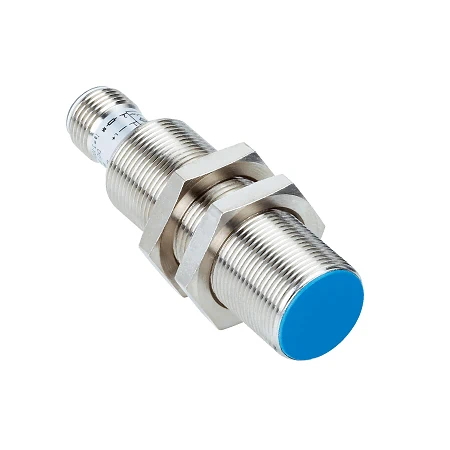
A machine stop can present a qualified metal carrier feature near the sensing face at its required transfer position. The 8 mm nominal and 6.48 mm assured ranges guide placement using non-flush mounting. The NC two-wire switching condition is evaluated by a compatible control circuit, with the specified load-current and external-fuse requirements met.
Problem Solved
A noncontact arrival signal gives the transfer control circuit a local carrier-position reference before advancing material, avoiding a mechanical lever touching each carrier during repeated handling cycles.
Carrier position
8 mm range
Two-wire NC
2. Checking a metal component at a fixture
An assembly fixture can bring a qualified metal component into the sensing zone at a defined inspection point. The switching condition reports local presence, while the listed reduction factors guide qualification of stainless steel, aluminum or copper targets. The external control circuit interprets the selected output function before proceeding with the next assembly operation.
Problem Solved
A metal-presence condition helps the external sequence control identify an empty monitored fixture position without relying on a visible surface mark or a contact probe against the component.
Fixture presence
Metal targets
Material factors
3. Counting spaced metal carriers on a conveyor
A conveyor can move separated qualified metal carrier features through the detection zone and supply the switching transitions to compatible external counting equipment. Target spacing and event rate must remain within 25 Hz on AC or 50 Hz on DC. The load circuit must also satisfy the minimum 5 mA requirement and documented off-state-current limits.
Problem Solved
A qualified carrier-passage event supports throughput tracking without a contact counting arm, while external equipment performs counting and coordinates the feed sequence at the monitored conveyor point.
Carrier counting
25 Hz AC / 50 Hz DC
External counter