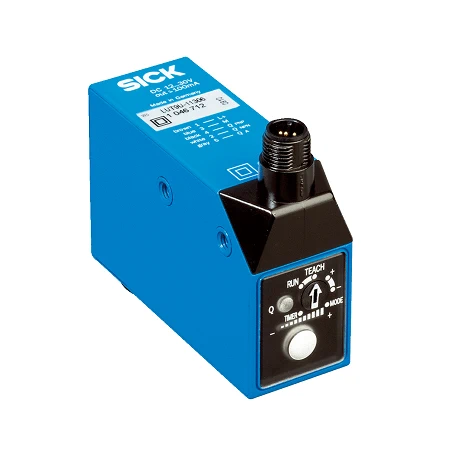
SICK 1046188 LUT9U-P120L IO-Link Luminescence Sensor

USD 1,446.90

375 nm UV luminescence sensor with 10–40 mm working range,PNP output,IO-Link V1.0,selectable timing modes and an M12 four-pin male connector.

SKU SICK-1046188 Category
SICK LUT9

SICK LUT9U-P120L UV Luminescence Sensor

BrandSICK
Model IdentifierLUT9U-P120L
Official Part Number1046188

Technical Overview

The SICK LUT9U-P120L is a luminescence sensor that detects fluorescent targets using a 375 nm ultraviolet LED and a 450–750 nm receiving range. Its 10–40 mm working range and 20 mm sensing distance from the lens front support placement of qualified marks. A vertical 3 ×9 mm spot and a receiving filter that blocks wavelengths up to 420 nm separate target fluorescence from shorter-wavelength background emission. The PNP switching output is supplemented by IO-Link V1.0 switching and measurement data, with a 2.3 ms communication cycle. Teach-in and manual threshold controls support setup. Selectable timing and switch-off-delay settings adapt the signal to external control equipment. The zinc diecast housing is rated IP67.

375 nm UV luminescence sensor with10–40 mm working range,3 ×9 mm vertical spot,PNP switching,IO-Link V1.0 and M12 four-pin connector.

Key Features

  • 375 nm ultraviolet LED;long-side light emission
  • 450–750 nm receiving range;filter blocks wavelengths≤420 nm
  • 10–40 mm working range;20 mm sensing distance from lens front
  • 3 ×9 mm vertical light spot
  • PNP switching output;IO-Link V1.0 switching and measurement data
  • 0.5/2.5/6.5 kHz switching-frequency selections;without timer
  • Static teach-in and manual threshold adjustment
  • Switch-off delay0/10/20 ms;default0 ms
  • M12 four-pin male connector
  • Zinc diecast IP67 housing;−10 to+55 °C operation

Detect qualified fluorescent marks with UV excitation,background-suppressing receiving filtration and external machine-control signals.

Technical Specification Matrix

ParameterValue
Functional principleUV luminescence detection of fluorescent targets
Housing formLarge
Light sourceUltraviolet LED
Wavelength375 nm
Light emissionLong housing side
Light spot size3 ×9 mm
Light spot directionVertical
Working range10–40 mm
Sensing distance20 mm from leading edge of lens
Receiving range450–750 nm
Receiving filterBlocks wavelengths≤420 nm to suppress shorter-wavelength background luminescence
Power supply10–30 V DC;short-circuit-protected supply network maximum8 A
Ripple<5 Vpp;supply voltage must remain within tolerances
Current consumption<100 mA without load
Switching outputPNP
Switching modeLight switching;light/dark selection via teach-in or IO-Link
Switching frequency0.5/2.5/6.5 kHz selectable;light/dark ratio1:1,without timer
Response time1 ms/200 µs/75 µs listed by manufacturer;selected timing mode applies
Output currentImax100 mA
Protection classII;reference voltage50 V DC
Circuit protectionSupply reverse-polarity protection;Q short-circuit protection;interference pulse suppression
ConnectionM12 four-pin male connector
Connector adjustmentRotatable up to90°
Housing materialZinc diecast
Main body width30.4 mm
Main body height53 mm
Main body depth80 mm
MountingM5 threaded mounting holes,5.5 mm deep
IndicatorsYellow switching-output indicator;green bar graph with leftmost power-on LED
Operating temperature−10 to+55 °C
Storage temperature−25 to+75 °C
Shock loadIEC60068
IP ratingIP67
Physical Weight (kg)0.4
AdjustmentStatic teach-in button;rotary selection;manual +/- threshold setting;IO-Link optional connection
Switch-off delay0/10/20 ms adjustable;0 ms default
IO-LinkV1.0
VendorID26
DeviceIDHEX80000F;DEC8388623
IO-Link cycle time2.3 ms
IO-Link process dataBit0=switching QL1;bits1–5 empty;bits6–15 analog measurement value
Pin assignment1/BN=L+;3/BU=M;2/WH=Q;4/BK=Q/C;CD-309
Bar graphIn RUN shows luminescence intensity independently of threshold;during static teach shows detection reliability

Industrial Applications

1. Registering fluorescent marks on a moving web

A converting machine can move a qualified fluorescent registration mark and its background through the 3 ×9 mm vertical spot. The 375 nm UV source excites the mark and the receiver evaluates its visible emission. Teach-in sets the mark/background threshold, and a compatible controller uses the PNP transition as a timing reference within the selected timing mode.

Problem Solved

A fluorescence-derived timing event gives the external web controller a registration reference when the mark is distinguished by UV-excited emission, without a mechanical index contact touching the moving material.

Web registration 375 nm UV Vertical spot

2. Checking qualified fluorescent adhesive at an assembly point

An assembly station can present an adhesive containing a qualified fluorescent tracer at a defined inspection location within the 10–40 mm working range. The sensor evaluates fluorescence against the local background using its threshold adjustment. The switching signal lets external control equipment inspect local adhesive presence; the test addresses the monitored spot and does not measure bond strength or full coverage.

Problem Solved

A local fluorescence-presence condition lets the external inspection sequence flag a missing monitored adhesive spot without depending on a visible color difference or contacting the applied material.

Adhesive presence Fluorescent tracer Threshold adjustment

3. Monitoring luminescence signal during machine setup

A setup station can acquire the analog measurement value carried in IO-Link process-data bits6–15 while presenting a qualified fluorescent mark and its background. The external interface can show the measurement alongside the bit0 switching condition. The 2.3 ms cycle provides the documented communication timing reference while the operator adjusts the taught threshold.

Problem Solved

Measurement and switching feedback help external setup tools reveal a weak mark/background separation or a changed fluorescent signal, reducing dependence on observing only the local switching indicator.

IO-Link measurement Switching feedback 2.3 ms cycle

Select your currency