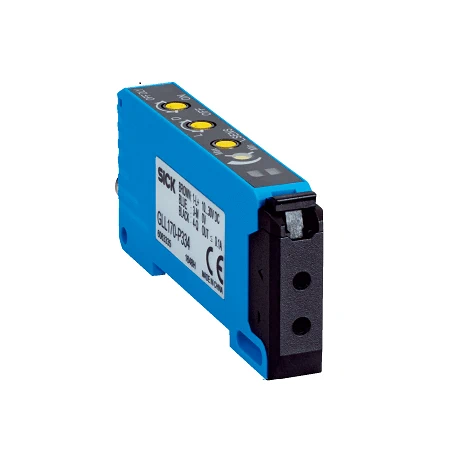
SICK 6063336 GLL170-P333 PNP Fiber-Optic Amplifier

USD 95.68

Stand-alone fiber amplifier with PNP output, eight-turn sensitivity adjustment, 2 kHz switching, selectable 40 ms off delay and M8 three-pin connector.

SKU SICK-6063336 Category
SICK GLL170

SICK GLL170-P333 PNP Fiber-Optic Amplifier

BrandSICK
Model IdentifierGLL170-P333
Official Part Number6063336

Technical Overview

The SICK GLL170-P333 is a stand-alone fiber-optic amplifier with one PNP output and a 632 nm visible red LED. The connected optical fiber determines the sensing arrangement and available range, keeping the optical head separate from the accessible adjustment unit. An eight-turn sensitivity potentiometer sets the switching threshold, while rotary selectors choose light/dark operation and enable or disable a fixed 40 ms off delay. Response time is no more than 250 µs, with 2 kHz switching frequency. Green signal-strength and output-state indicators aid adjustment. The amplifier operates from 10–30 V DC and provides an M8 three-pin connector in an IP66 PC/POM housing.

PNP stand-alone fiber amplifier with eight-turn sensitivity control, 2 kHz switching, fixed 40 ms off delay selectable on/off and an M8 three-pin connector.

Key Features

  • Stand-alone fiber amplifier with one PNP output
  • Fiber-dependent sensing arrangement and range
  • 632 nm visible red LED
  • Eight-turn sensitivity potentiometer; 230° sensitivity scale
  • Rotary selection of light or dark switching
  • Response≤250 µs; switching frequency2 kHz
  • Fixed40 ms off delay selectable ON/OFF
  • Green signal-strength indicator and output-state LED
  • 10–30 V DC supply; M8 three-pin connector
  • IP66 PC/POM housing; operating temperature−25 to+55 °C

Set the fiber sensing threshold with an eight-turn potentiometer and bridge brief light-state interruptions with a selectable fixed 40 ms off delay.

Technical Specification Matrix

ParameterValue
Functional principleStand-alone fiber-optic amplifier
Sensing principle and rangeDependent on the connected optical fiber
Light sourceLED,visible red light
Wavelength632 nm
LED risk groupFree group;EN62471:2008-09/IEC62471:2006 modified
Sensitivity adjustmentEight-turn potentiometer;230° sensitivity scale
Digital output1 × PNP
Switching modeLight/dark switching;L.ON/D.ON rotary selector
Response time≤250 µs
Switching frequency2 kHz
Time functionsNo delay or fixed40 ms off delay;ON/OFF rotary selector
Power supply10–30 V DC;limit values
Residual ripple≤10%;remain within supply-voltage limits
Current consumption≤30 mA without load
Output current≤100 mA
PNP signal voltageHIGH approximately supply voltage−1.5 V;LOW approximately0 V
Protection classIII
Output protectionReverse-polarity,overcurrent and short-circuit protection
ConnectionM8 three-pin connector
Pin assignment1/BN=L+;3/BU=M;4/BK=Q;CD-045
Housing formRectangular
Housing materialPC/POM plastic
IP ratingIP66 per EN60529
Operating temperature−25 to+55 °C
Storage temperature−40 to+70 °C
Relative humidity35–95%;non-condensing
Ambient light immunityTypical artificial light≤5000 lx;sunlight≤60000 lx
Shock resistance50 g,11 ms;18 shocks acrossX/Y/Z;EN60068-2-27
Vibration resistance10–55 Hz,1 mm;3 ×30 min;EN60068-2-6
EMCEN60947-5-2
Green indicatorPower/signal-strength indicator;dimmed within±10%of switching threshold
Output indicatorLED indicates digital-output state
Maximum fixing-screw torque0.5 Nm
UL fileNRKH2.E300503 and NRKH8.E300503
MTTFD760 years
Diagnostic coverage DCavg0%
Mission time20 years
Physical Weight (kg)0.019

Industrial Applications

1. Counting separated parts through a fiber beam

A feeder can position a compatible through-beam fiber pair across a constrained component path and mount the amplifier where its sensitivity control is accessible. Separated parts interrupt the beam and change the PNP output. External control counts the transitions, with event timing constrained by the specified250 µs response and2 kHz switching frequency.

Problem Solved

A fiber-guided optical path supplies discrete count events in a confined feed location while the amplifier remains accessible for sensitivity adjustment and output-state review.

Fiber beam PNP 2 kHz

2. Checking a part in a confined fixture

An assembly fixture can place a compatible reflective fiber head near the expected part position while locating the amplifier outside the crowded tooling area. The eight-turn potentiometer establishes a threshold between the selected part and background signals. The PNP output reports the resulting condition, and the green indicator helps assess the signal near that threshold.

Problem Solved

Separating the optical head from the adjustment unit supports a local fixture-presence check while preserving access to threshold control and the received-signal indicator.

Remote fiber head Eight-turn adjustment Presence check

3. Bridging short gaps in material feed

A material feeder can use a compatible fiber arrangement to monitor an occupied feed path and select the amplifier off-delay function. When a brief interruption changes the sensed light condition, the fixed40 ms delay postpones release of the configured output. A sustained absence allows the output to release after that delay, providing a changed PNP condition to external control.

Problem Solved

The selected off delay bridges short interruptions in the material signal, helping external control distinguish brief feed gaps from a sustained absence without adding a separate timing element.

Fixed40 ms off delay Fiber sensing PNP

Select your currency