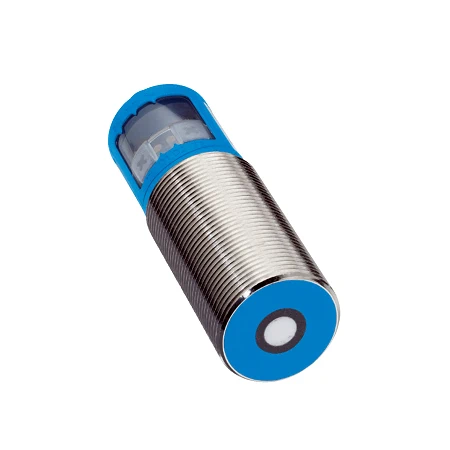
1. Monitoring material level in a large vessel
A vessel can present a sufficiently reflecting material surface within the 30–250 mm operating range. The sensor is aligned to the surface, and its local controls teach the required distance conditions for Q1 and Q2. External level control evaluates the NPN switching results after checking actual material echoes, temperature stabilization and the 32 ms response against the filling cycle.
Problem Solved
A taught surface-distance condition gives external filling control a repeatable process threshold, helping it recognize when the material surface reaches the selected level without contacting the material.
Material level
Taught thresholds
External filling control
2. Checking the position of a large load face
A handling station can present a reflecting load face within the 30–250 mm operating range and configure an acceptance window using the local display and controls. External sequence control interprets the selected NPN output condition before the next transfer step. Actual target alignment, window boundaries and return strength are validated, and the configured measurement filters are matched to the presentation cycle.
Problem Solved
A distance window provides external handling control with a selected acceptance zone for a large load face, helping it recognize an object placed too near or too far before transfer.
Load face
Acceptance window
Local settings
3. Coordinating adjacent ultrasonic process stations
Adjacent process stations can connect compatible sensors through MF pin 5 and configure synchronization or addressed multiplexing to manage ultrasonic interference. Each target remains within its sensor operating range, and external control evaluates the configured digital results. Up to 50 sensors can be interconnected, while actual geometry, target returns and timing are validated for the selected coordination mode.
Problem Solved
Coordinated ultrasonic operation helps external process control obtain usable target-distance conditions at adjacent stations where independent transmissions could interfere, supporting a practical sensing arrangement across several detection points.
Sensor coordination
MF connection
Adjacent stations