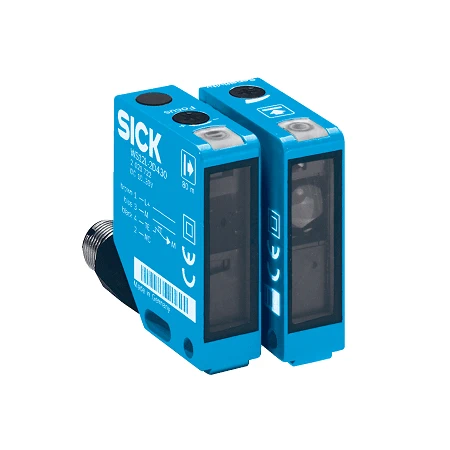
1. Counting separated opaque products
A conveyor can align the sender and receiver across the path of separated opaque products. Each product interrupts the direct laser beam and changes the complementary signals for external counting logic. The installed separation stays within the 0–80 m maximum range; commissioning checks actual beam coverage, product size, spacing and clear intervals against the optical geometry and switching requirements.
Problem Solved
Direct-beam interruption gives external counting logic a product-passage reference, helping track separated conveyor loads without depending on light reflected from each changing product surface finish.
Opaque products
Direct laser beam
Complementary signals
2. Monitoring an opaque web for loss of material
A feeder can place an opaque web between the aligned sender and receiver so normal material blocks the direct beam. A break exposes the receiver and changes the switching state for external feeder control. Installation verifies web width, flutter tolerance and sufficient beam interruption at the actual operating distance, using the typical Ø150 mm at 60 m as a reference rather than a guaranteed minimum detectable web width.
Problem Solved
A blocked-to-clear direct-beam transition supplies external feeder control with a possible material-loss indication, helping recognize a break before downstream equipment continues without the expected opaque feed.
Web continuity
Beam interruption
External feeder control
3. Recognizing occupancy at a transfer point
A transfer station can mount the sender and receiver on opposite sides of an expected load position. A load remaining in the beam maintains the interrupted condition, which external control evaluates over time using its own dwell timer. The complementary signals provide alternative process states for the control circuit, while head alignment and actual load coverage are checked during commissioning.
Problem Solved
Sustained beam interruption provides external transfer control with an occupied-position reference, helping coordinate upstream release when a load remains in place instead of clearing after its normal transfer cycle.
Transfer occupancy
External dwell timing
Aligned sender/receiver