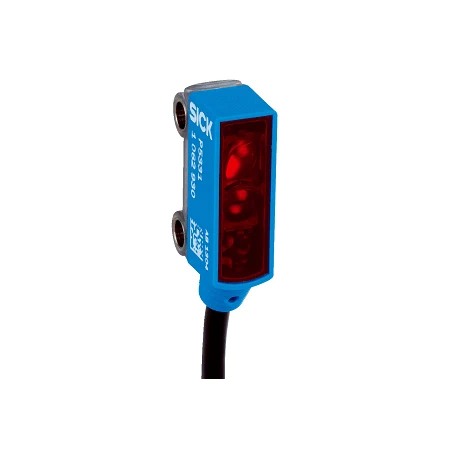
SICK 1065934 WL2SG-2N1135 NPN Transparent-object Sensor

USD 139.10

WL2SG-2N1135 offers 0–0.55 m P250F sensing, 640 nm PinPoint LED light, AutoAdapt, cable teach-in, NPN light switching and a 2 m PVC cable.

SKU SICK-1065934 Category
SICK W2SG-2

SICK WL2SG-2N1135 Transparent-object Retro-reflective Sensor

BrandSICK
Model IdentifierWL2SG-2N1135
Official Part Number1065934

Technical Overview

The SICK WL2SG-2N1135 is a miniature photoelectric retro-reflective sensor for detecting transparent objects. Polarized coaxial optics work without a reflector minimum distance, providing a 0–0.55 m sensing range and 0–1.2 m maximum range with P250F. A 640 nm visible red PinPoint LED produces a 12 mm spot at 250 mm. Cable-based adjustment and AutoAdapt support setup, while an NPN light-switching output connects to external machine control. Response is below 0.5 ms with a resistive load, and switching frequency is 1,000 Hz at a 1:1 light/dark ratio. The ABS/PC housing, PMMA optics, IP67 protection and 2 m four-wire PVC cable support compact installation.

Miniature transparent-object retro-reflective sensor with 0–0.55 m P250F range, PinPoint LED, AutoAdapt, cable teach-in and NPN light switching.

Key Features

  • Transparent-object detection using polarized coaxial retro-reflective optics
  • No reflector minimum distance
  • 0–0.55 m sensing and 0–1.2 m maximum range with P250F
  • 640 nm visible red PinPoint LED; Ø12 mm spot at 250 mm
  • Cable teach-in through white wire; AutoAdapt
  • NPN light-switching output, ≤50 mA
  • <0.5 ms response with resistive load; 1,000 Hz at 1:1 light/dark ratio
  • 10–30 V DC; 20 mA without load
  • 2 m four-wire PVC cable; do not bend below 0 °C
  • ABS/PC housing, PMMA optics, IP67; −20 to +50 °C operation

Detect transparent objects across a short reflected-light path with coaxial optics, cable adjustment and an NPN light-switching signal.

Technical Specification Matrix

ParameterValue
Functional principlePhotoelectric retro-reflective sensing with polarized coaxial/autocollimation optics
Special applicationDetecting transparent objects
Sensing range0–0.55 m with P250F reflector
Maximum sensing range0–1.2 m with P250F reflector
Reflector minimum distanceNo minimum distance with coaxial optics
Light sourceVisible red PinPoint LED
Wavelength640 nm
Light spot sizeØ12 mm at 250 mm
LED service lifeAverage 100,000 h at ambient +25 °C
AdjustmentCable teach-in through white wire
AutoAdaptYes
Digital outputNPN light-switching output; maximum output current ≤50 mA
Switching modeLight switching
Pin assignmentBN=L+; BU=M; BK=Q; WH=Teach (CD-093)
Response time<0.5 ms signal transit time with resistive load
Switching frequency1,000 Hz at 1:1 light/dark ratio
Power supply10–30 V DC, limit values
Residual ripple<5 Vpp; remain within supply tolerances
Current consumption20 mA without load
Circuit protectionA: supply reverse-polarity protection; B: output reverse-polarity protection; D: outputs overcurrent and short-circuit protection
Polarization filterYes
Housing designRectangular
Housing materialABS/PC plastic
Optics materialPMMA plastic
Connection2 m four-wire PVC cable; do not bend below 0 °C
Conductor cross-section0.09 mm²
Cable diameterØ3 mm
Mounting provisionsFixing holes Ø3.2 mm, drawing center axes
IP ratingIP67
Operating temperature−20 to +50 °C
Storage temperature−40 to +75 °C
MTTFD2,001 years
DCavg0%

Industrial Applications

1. Counting separated clear containers

A packaging feeder can mount the sensor opposite a P250F reflector so separated clear containers pass through the reflected-light path. Cable teach-in establishes detection using actual container material, wall shape and contents. External counting logic evaluates the NPN light-switching output, with spacing and sampling checked against the 1,000 Hz specification at a 1:1 light/dark ratio and the 0–0.55 m P250F sensing range.

Problem Solved

A transparent-container passage reference helps external counting logic track clear products whose transmitted light makes ordinary opaque-object detection unsuitable, after actual container presentation and separation have been verified.

Clear containers NPN light switching External counting

2. Confirming a clear carrier at a transfer stop

A compact transfer station can align the sensor and P250F reflector across a defined wall of a clear carrier at its seated position. Coaxial optics avoid a reflector minimum distance, and the 2 m cable supports local installation. Setup teaches using representative carriers and verifies that nearby machine features remain outside the intended optical path throughout carrier movement.

Problem Solved

A clear-carrier position reference helps external transfer control recognize arrival at the intended location, supporting coordinated upstream release after carrier wall geometry and the seated position have been checked.

Clear carrier Coaxial optics Transfer position

3. Checking a transparent cover on a presented assembly

An assembly nest can present a transparent cover across the reflected-light path at a defined inspection point. Cable teach-in establishes detection with representative covered and uncovered assemblies, while the transparent-object sensing function evaluates the cover condition. External inspection logic samples the switching output at the intended stage after verifying cover material, curvature, presentation tolerance and nearby background interference on the actual assembly.

Problem Solved

A cover-present reference helps external inspection logic identify an assembly missing its transparent cover, reducing the chance that a cover omission proceeds unnoticed to the following operation.

Transparent cover Assembly inspection Cable teach-in

Select your currency