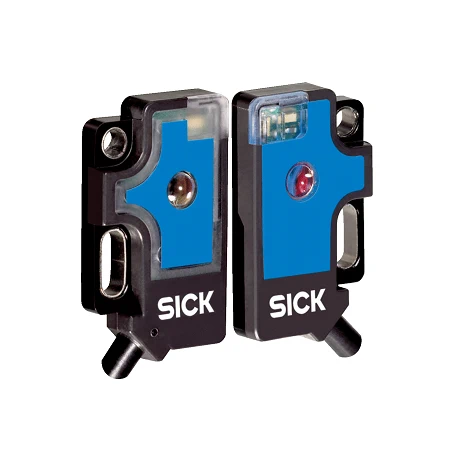
1. Counting separated opaque parts at a small chute
A small-parts chute can place the sender and receiver on opposite sides of a clear opening within the 0–0.4 m sensing range. Each separated opaque part interrupts the beam as it falls. External counting logic evaluates the PNP output, with the part profile, spacing and transit speed checked against the beam geometry and switching limits.
Problem Solved
A discrete passage reference helps external counting logic register separated parts at a narrow chute without depending on light returned from each part surface.
Small-parts chute
Beam interruption
External counting
2. Confirming a carrier at a compact transfer stop
A transfer station can align the sender and receiver across an opaque feature of a carrier at its seated position. The 0–0.4 m sensing range supports a short optical crossing, while the separate receiver supplies the switching state. External transfer control samples that state before coordinating release, after the actual carrier geometry and seated tolerance have been checked.
Problem Solved
A carrier-arrival reference helps external transfer control coordinate a staged handoff, using an interrupted optical path to distinguish the seated carrier from an empty stop.
Carrier arrival
Transfer stop
Separate receiver
3. Monitoring an opaque strip edge at a guide
A strip guide can position the sender and receiver across a defined edge location so that an opaque strip normally interrupts the beam. Lateral movement that uncovers the path changes the receiver output. External process control evaluates that condition as a discrete edge-presence reference, with strip opacity, flutter and actual alignment checked during installation.
Problem Solved
A discrete strip-edge reference helps external process control recognize an uncovered guide position without requiring a reflective target surface or a reflector behind the moving strip.
Opaque strip
Edge presence
Through-beam optics