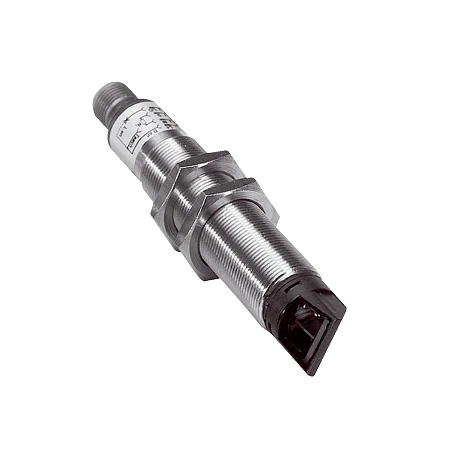
SICK 6027422 PNP Laser Diffuse Photoelectric Sensor

USD 224.12

VTE18L-4P344 offers 5–200 mm reference-white sensing, radial focused laser optics, local/control-input teaching, selectable PNP output and M12 connection.

SKU SICK-6027422 Category
SICK V18 Laser

SICK VTE18L-4P344 Laser Diffuse Photoelectric Sensor

BrandSICK
Model IdentifierVTE18L-4P344
Official Part Number6027422

Technical Overview

The SICK VTE18L-4P344 is an energetic laser photoelectric proximity sensor with a radial optical path and focused optics. It evaluates light reflected from the target, providing 5–200 mm sensing and 2–250 mm maximum range on 90% remission reference white. The 650 nm Class 1 laser has 0.4 mW output and a 5 mm spot at 200 mm. A local button or control input C at 0 V teaches the sensing condition, while C also selects PNP light/dark switching. Response is no more than 0.625 ms with resistive load, with 800 Hz switching at a 1:1 light/dark ratio. The M18 × 1 threaded housing, protective glass pane, M12 four-pin connector and IP67 protection support machine integration.

Focused energetic laser sensor with 5–200 mm reference-white range, radial optics, local/control-input teaching and selectable PNP switching.

Key Features

  • Energetic reflected-light sensing with focused radial optics
  • 5–200 mm sensing on 90% remission reference white
  • 2–250 mm maximum range on reference white
  • 650 nm visible red Class 1 laser; 0.4 mW output
  • Ø5 mm at 200 mm
  • Local teach-in button and electronic control input C at 0 V
  • PNP output; light/dark selection via C; maximum current ≤100 mA
  • ≤0.625 ms response with resistive load; 800 Hz at 1:1 light/dark ratio
  • 10–30 V DC; 30 mA without load; M12 four-pin connector
  • M18 × 1 nickel-plated brass/PC housing; protective glass pane; IP67

Teach a reflected-light condition from one mounting side and use the laser sensor’s switching state to support external component or position checks.

Technical Specification Matrix

ParameterValue
Functional principleEnergetic photoelectric proximity sensor
Optical axisRadial
Sensing range5–200 mm on 90% remission reference white (DIN 5033)
Maximum sensing range2–250 mm on 90% remission reference white (DIN 5033)
Light sourceVisible red laser
Wavelength650 nm
Laser class1, IEC 60825-1
Laser power output0.4 mW
Light spot sizeØ5 mm at 200 mm
Laser service lifeAverage 100,000 h at ambient +25 °C
AdjustmentA local teach-in button or electronic control input C at 0 V
Special applicationDetecting small objects
Digital outputPNP switching output; maximum current ≤100 mA
Switching modeLight/dark switching, selectable via control input C
Response time≤0.625 ms signal transit time with resistive load
Switching frequency800 Hz at 1:1 light/dark ratio
Power supply10–30 V DC, limit values
Residual ripple±10%; remain within supply tolerances
Current consumption30 mA without load
Protection classIII
Circuit protectionA: supply reverse-polarity protection; B: inputs and output reverse-polarity protection; C: interference suppression; D: outputs overcurrent and short-circuit protection
Housing designCylindrical; M18 × 1 threaded housing
Housing materialNickel-plated brass / PC
Optics materialPC plastic with protective glass pane
ConnectionM12 four-pin male connector
Pin assignment1 BN=L+; 2 WH=C; 3 BU=M; 4 BK=Q (CD-099)
IP ratingIP67
Operating temperature−15 to +55 °C
Storage temperature−25 to +70 °C
Physical Weight (kg)0.06
Green LED indicatorSupply voltage present
Yellow LED indicatorContinuous: reception signal above reserve factor 2; blinking: below reserve factor 2 but above switching threshold 1
Items suppliedTwo metal fastening nuts, width across flats 24 mm
Special featureFocused optics

Industrial Applications

1. Counting separated tabs at a component guide

A component guide can present separated tabs within the 5–200 mm white-target sensing range. Energetic optics evaluate light reflected from each tab, while local or electronic teaching establishes the working sensitivity. External counting logic evaluates the PNP output using the selected light/dark mode. Setup checks actual tab reflectance, spacing and transit speed against the optical response and switching limits.

Problem Solved

A tab-passage reference helps external counting logic register separated features from one mounting side, with teaching available to establish detection for the presented target condition.

Tab counting Sensitivity teaching Reflected-light sensing

2. Checking an insert in an assembly nest

An assembly nest can present a small insert at a repeatable distance facing the sensor. Button or electronic teaching establishes a reflected-light condition using representative assemblies. External inspection logic samples the switching output when the assembly is stationary. Actual insert material, background and placement tolerance are checked because energetic detection depends on the returned light level.

Problem Solved

An insert-present reference helps external inspection logic identify an empty assembly location before the next operation, using a taught reflected-light condition at a repeatable nest position.

Insert presence Assembly nest Electronic teaching

3. Confirming a carrier against a transfer stop

A transfer stop can bring a defined carrier surface into the sensor’s working distance. Energetic sensing and the taught sensitivity provide a discrete arrival condition, while control input C selects the required light/dark output behavior. External transfer logic samples the state after setup verifies actual carrier reflectance and seated gap, with representative target surfaces at the installed distance.

Problem Solved

A seated-carrier reference helps external transfer logic coordinate release at a compact stop, using light returned from a nearby surface and keeping the optical components on one mounting side.

Carrier arrival Transfer stop Selectable switching

Select your currency