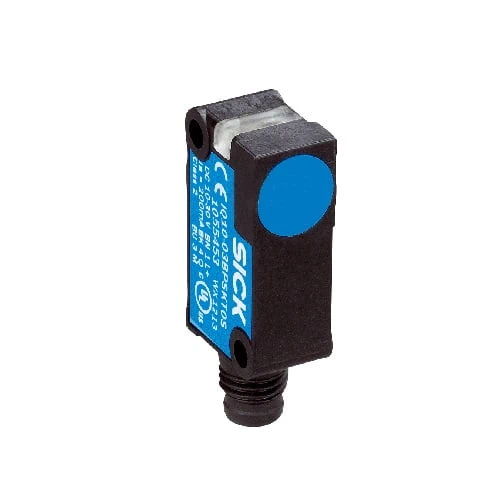
SICK 1055458 IQ10-06NPOKW2S PNP NC Inductive Sensor

USD 59.80

IQ10-06NPOKW2S offers 6 mm nominal inductive sensing, PNP NC output, 2,000 Hz switching, a 2 m three-wire PVC cable and IP68 VISTAL housing.

SKU SICK-1055458 Category
SICK IQB

SICK IQ10-06NPOKW2S PNP NC Inductive Proximity Sensor

BrandSICK
Model IdentifierIQ10-06NPOKW2S
Official Part Number1055458

Technical Overview

The SICK IQ10-06NPOKW2S is a rectangular inductive proximity sensor with non-flush installation and a PNP normally closed output. Its nominal sensing distance is 6 mm, with an assured sensing distance of 4.86 mm and 2,000 Hz switching frequency. A 2 m three-wire PVC cable connects the sensor to a 10–30 V DC circuit, with 10 mA no-load current and continuous output current up to 200 mA. The housing and sensing face use VISTAL plastic, with IP68 protection and a −25 to +75 °C operating range. Short-circuit protection and power-up pulse suppression are provided; a 270° LED indicator supports local observation.

Non-flush inductive sensor with 6 mm nominal distance, PNP NC output, 2,000 Hz switching, 2 m PVC cable and IP68 VISTAL construction.

Key Features

  • Rectangular inductive proximity sensor for non-flush installation
  • Nominal sensing distance 6 mm; assured sensing distance 4.86 mm
  • PNP normally closed output; DC three-wire connection
  • 2,000 Hz switching frequency; ≤100 ms availability delay
  • 10–30 V DC; 10 mA no-load current; ≤200 mA continuous output
  • 2 m three-wire PVC cable; 0.25 mm² conductors; Ø3.7 mm cable
  • VISTAL plastic housing and sensing face; IP68, EN 60529
  • Short-circuit protection and power-up pulse protection
  • 270° LED indicator; tightening torque ≤1 Nm
  • −25 to +75 °C operation; 30 g/11 ms shock resistance

Detect a nearby metal target through a non-flush inductive sensing face and provide a PNP normally closed signal through a 2 m cable.

Technical Specification Matrix

ParameterValue
Sensor principleInductive proximity sensing
Housing designRectangular
Nominal sensing distance Sn6 mm
Assured sensing distance Sa4.86 mm
InstallationNon-flush
Switching frequency2,000 Hz
Digital outputPNP, normally closed
Electrical wiringDC three-wire
Power supply10–30 V DC
Ripple≤10% of supply voltage
Voltage drop≤3 V at maximum output current
Availability delay≤100 ms
Hysteresis5–15%
Reproducibility≤2% of Sr at constant supply voltage and ambient temperature
Temperature drift±10% of Sr
Continuous output current≤200 mA
No-load current10 mA
Connection2 m three-wire PVC cable
Conductor cross-section0.25 mm²
Cable diameterØ3.7 mm
Wire assignmentCD-003: BN=L+; BK=NC output; BU=M
Short-circuit protectionProvided
Power-up pulse protectionProvided
Housing materialVISTAL plastic
Sensing-face materialVISTAL plastic
IndicatorLED, 270° visibility shown in drawing
Maximum tightening torque≤1 Nm
IP ratingIP68, EN 60529
Operating temperature−25 to +75 °C
Shock resistance30 g, 11 ms
Vibration resistance10–55 Hz, 1 mm
EMCEN 60947-5-2
Material reduction factorsReference values, may vary: V2A/304 stainless steel 0.7; aluminum 0.5; copper 0.35; brass 0.5
Installation drawing clearancesA=7; B=30; C=10.3; D=18; E=8; F=48; G=12 mm, applied according to manufacturer non-flush drawing

Industrial Applications

1. Confirming a metal carrier at a stop

A transfer stop can bring a metal carrier feature close to the sensing face. The sensor provides a PNP normally closed signal for external sequencing logic, using non-flush mounting clearance and a gap within the assured sensing distance. Setup checks the actual target material because the stated reduction factors give different reference responses for stainless steel, aluminum, copper and brass.

Problem Solved

A carrier-position reference helps transfer logic recognize the intended stop condition, using inductive sensing and an NC signal configured for the controller’s input circuit.

Carrier position Metal target PNP NC

2. Counting passing metal tabs on a mechanism

A rotating or translating mechanism can present separated metal tabs across the active sensing face. The 2,000 Hz switching specification guides selection of tab spacing and motion speed, while external counting logic evaluates the PNP NC transitions. Commissioning verifies actual tab size, material, passing gap and controller timing, with non-flush clearances applied around the sensor and nearby metal.

Problem Solved

Inductive switching transitions help external counting logic register individual metal features, with the documented frequency and installation clearances supporting the selected mechanical arrangement.

Tab counting Inductive events Motion timing

3. Checking a metal insert in an assembly nest

An assembly nest can present a metal insert at a repeatable position facing the sensor. External inspection logic samples the NC output when the workpiece is seated, after setup verifies the insert material and actual gap against the assured sensing distance. The 2 m cable and 270° indicator support connection and local state observation during commissioning of the nest.

Problem Solved

A metal-insert reference helps inspection logic identify whether the intended component is presented at the sensing point, using a defined gap and visible local indication.

Insert presence Assembly nest Local indication

Select your currency