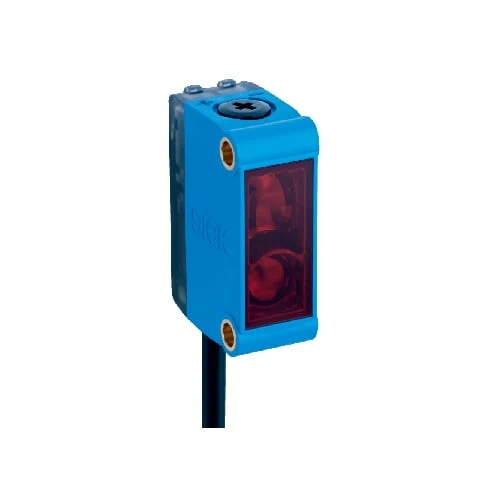
1. Detecting a component at a compact assembly station
An assembly station can present a component closer to the sensor than the fixed nest structure. The five-turn spindle adjusts the detection zone, and background suppression supports separating the intended target from the farther background. External logic samples the PNP output after actual component reflectance and placement tolerance have been checked against the target-specific range diagram.
Problem Solved
A component-presence reference helps assembly logic distinguish the intended loaded condition, using a compact adjusted sensing zone and a discrete output selected for the control input.
Component presence
Assembly station
Background suppression
2. Counting separated packages at a transfer point
A transfer point can pass separated packages through the specified 35–140 mm sensing zone and feed the PNP output to external counting logic. The 1,000 Hz switching specification and <625 µs response guide checks of package speed and gap. Commissioning verifies actual target reflectance, interruption duration and controller timing before interpreting each event as a package passage.
Problem Solved
A discrete target-passage signal helps counting logic register separated packages, with documented optical and electrical timing matched to the actual transfer sequence.
Package counting
Transfer point
Switching timing
3. Confirming a carrier at a defined stop
A carrier stop can bring a repeatable surface into the adjusted detection zone. M3 mounting holes support positioning, and the light/dark rotary switch selects the output state required by external release logic. Setup checks the seated gap, surface remission and separation from surrounding structure; the 2 m cable connection carries the switching signal to the control circuit.
Problem Solved
A seated-carrier input helps release logic coordinate the next transfer from a defined position, using local range adjustment and a selectable light/dark switching state.
Carrier arrival
Transfer release
Local adjustment