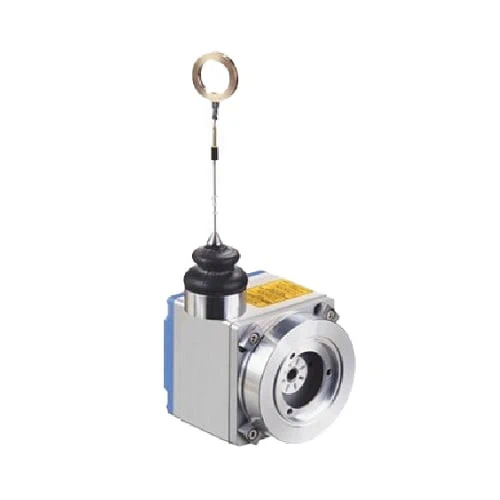
1. Converting carriage travel into encoder rotation
A linear carriage can attach to the measuring wire while a compatible separately selected encoder mounts to the mechanism. As the carriage moves, wire travel produces encoder rotation at the documented 334.1 mm per revolution. External control converts the selected encoder signal into position, with setup checking wire alignment, the 0–5 m measuring span, return force and mechanical mounting.
Problem Solved
The wire-to-rotation relationship helps a separate encoder and controller track linear carriage position, using a known mechanical conversion over the mechanism’s specified measuring range.
Linear carriage
Separate encoder
Mechanical conversion
2. Deriving linear traverse speed with external electronics
A moving machine section can pull the wire while a compatible rotary encoder reports rotation to external speed-monitoring electronics. The controller converts rotational rate into linear travel rate using 334.1 mm per revolution. Engineering checks the complete encoder bandwidth and mechanical connection, keeps motion within the mechanism’s 8 m/s specification and accounts for the documented spring return force.
Problem Solved
A known wire-travel ratio helps external electronics derive traverse speed from a separate encoder’s rotation signal, linking linear movement to the commissioned rotary measurement system.
Traverse speed
Travel ratio
External calculation
3. Checking repeated stroke endpoints on a test fixture
A test fixture can connect the wire to a repeatedly moving part and use a separate encoder to record stroke endpoints. The mechanism’s reproducibility, linearity and hysteresis inform the fixture’s measurement budget alongside the selected encoder. Setup checks the used stroke, wire alignment and return loading, while cycle-life expectations account for the actual environment, speed and acceleration.
Problem Solved
Wire-based motion conversion helps an external test system compare repeated stroke endpoints, with mechanism and encoder errors included when interpreting the measured variation.
Stroke testing
Endpoint comparison
Measurement budget