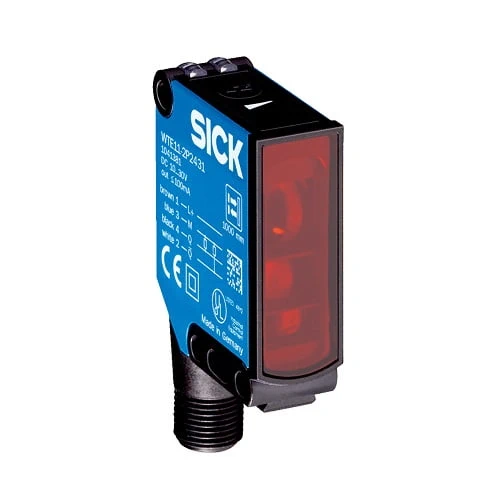
SICK 1041381 WTE11-2P2432 PNP Diffuse Photoelectric Sensor

USD 155.74

WTE11-2P2432 offers 40–600 mm reference-white sensing, 633 nm red LED light, single-button teach-in, complementary PNP outputs and M12 connection.

SKU SICK-1041381 Category
SICK W11-2

SICK WTE11-2P2432 PNP Diffuse Photoelectric Sensor

BrandSICK
Model IdentifierWTE11-2P2432
Official Part Number1041381

Technical Overview

The SICK WTE11-2P2432 is an energetic photoelectric proximity sensor that evaluates red light reflected from a target. Its sensing range is 40–600 mm on reference white, with a 40–1,000 mm maximum range and shorter useful distances for darker targets. A single teach-in button adjusts detection. The 633 nm LED produces a 90 mm spot at 600 mm, while complementary PNP outputs provide light/dark switching. Response is no more than 2.5 ms with resistive load and switching frequency is 200 Hz at a 1:1 light/dark ratio. The 10–30 V DC device uses an M12 four-pin connector, ABS housing and PMMA optics, with IP66/IP67 protection and −30 to +60 °C operation.

PNP Diffuse Photoelectric Sensor with 40–600 mm reference-white sensing, single-button teach-in, complementary outputs and M12 connection.

Key Features

  • Energetic photoelectric proximity sensor
  • Sensing range: 40–600 mm on 90% remission reference white (DIN 5033)
  • Maximum range: 40–1,000 mm on 90% remission reference white (DIN 5033)
  • 633 nm visible red LED; Ø90 mm at 600 mm
  • Single teach-in button
  • PNP complementary outputs
  • ≤2.5 ms response with resistive load; 200 Hz at 1:1 light/dark ratio
  • 10–30 V DC; 30 mA without load; ≤100 mA output current
  • M12 four-pin male connector
  • IP66 / IP67; ABS housing; −30 to +60 °C operation

Adjust reflected-light detection for the actual target and connect the PNP switching state to external machine control.

Technical Specification Matrix

ParameterValue
Functional principleEnergetic photoelectric proximity sensor
Housing designRectangular
Sensing range40–600 mm on 90% remission reference white (DIN 5033)
Maximum sensing range40–1,000 mm on 90% remission reference white (DIN 5033)
Light sourceVisible red LED
Wavelength633 nm
Light spot sizeØ90 mm at 600 mm
LED service lifeAverage 100,000 h at ambient +25 °C
AdjustmentSingle teach-in button
Switching outputPNP; complementary outputs
Switching modeLight/dark switching through complementary outputs
Signal voltage HIGH/LOWSupply voltage −2.5 V / approximately 0 V
Output current≤100 mA
Response time≤2.5 ms with resistive load
Switching frequency200 Hz at 1:1 light/dark ratio
Power supply10–30 V DC; limit values in a short-circuit-protected network, maximum 8 A
Ripple<5 Vpp; remain within supply tolerances
Current consumption30 mA without load
ConnectionM12 four-pin male connector
Electrical protectionSupply reverse-polarity protection; interference suppression; output overcurrent and short-circuit protection
Housing materialABS
Optics materialPMMA
IP ratingIP66 / IP67
Operating temperature−30 to +60 °C
Storage temperature−40 to +75 °C
MTTFD1,342 years
Diagnostic coverageDCavg 0%
MountingØ4.2 mm mounting holes
IndicatorsGreen: supply voltage active; yellow: received-light status
Protection classIII
Mission time20 years
UL filesNRKH.E181493 and NRKH7.E181493
Pin assignmentCD-083: 1 BN=L+; 2 WH=Q̄; 3 BU=M; 4 BK=Q
Physical Weight (kg)0.12

Industrial Applications

1. Confirming a component in an assembly nest

An assembly nest can present a component at a repeatable distance facing the sensor. Energetic reflected-light sensing provides a switching condition from one mounting side, while the documented adjustment establishes detection for representative components. External inspection logic samples the output after the component settles. Setup verifies actual target reflectance, placement tolerance and background geometry before accepting the installed detection point.

Problem Solved

A component-present reference helps external inspection logic distinguish an occupied assembly location from an empty nest, using commissioned target geometry and the documented adjustment method.

Assembly presence Energetic reflected-light sensing External inspection

2. Counting separated components on a guide

A component guide can move separated parts through the optical sensing point and send switching transitions to external counting electronics. Commissioning establishes the working gap and adjustment using representative materials, including the darkest expected target. Part transit time and gaps are checked against the documented response and switching-frequency conditions before setting the counting logic.

Problem Solved

A discrete optical passage signal helps external counting electronics register separated components, using a commissioned sensing point and timing conditions matched to the actual parts feed.

Part counting Target reflectance Timing checks

3. Confirming a carrier at its transfer stop

A transfer stop can bring a defined carrier surface into the sensor’s working distance. External sequencing logic reads the optical switching state after the carrier reaches its seated position. Setup uses the documented adjustment and verifies actual carrier reflectance, gap tolerance and background geometry, then confirms that the selected light/dark behavior matches the connected process input.

Problem Solved

A seated-carrier condition helps external sequencing logic coordinate the next transfer step, using a checked optical gap and switching behavior for the actual carrier surface.

Carrier arrival Transfer stop Process sequencing

Select your currency