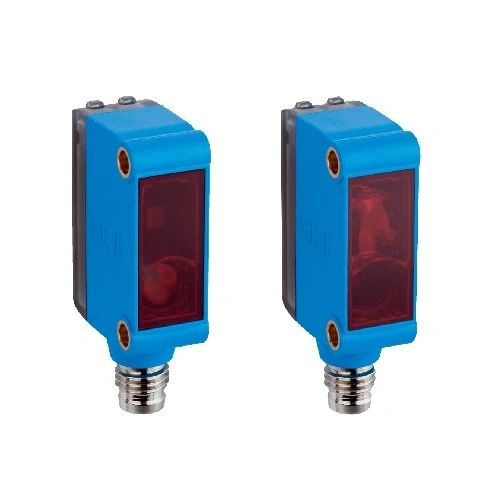
SICK 1060795 GSE6-N1212 NPN Through-beam Sensor Set

USD 74.62

GSE6-N1212 provides 0–10 m through-beam sensing, 650 nm red light, selectable NPN switching and 270° sensitivity adjustment with 2 m PVC cables.

SKU SICK-1060795 Category
SICK G6

SICK GSE6-N1212 NPN Through-beam Photoelectric Sensor Set

BrandSICK
Model IdentifierGSE6-N1212
Official Part Number1060795

Technical Overview

The SICK GSE6-N1212 is a through-beam photoelectric sensor set with separate sender and receiver. Its 650 nm red PinPoint LED establishes a beam between the units, with 0–10 m sensing and 0–15 m maximum range. The NPN receiver supports light/dark selection, response below 500 µs with resistive load and 1,000 Hz switching at a 1:1 light/dark ratio. A 270° potentiometer adjusts sensitivity, and a stainless steel BEF-W100-A mounting bracket is supplied. Each unit connects through a 2 m three-wire PVC cable. The 10–30 V DC devices use ABS/PC housings, PMMA front screens, M3 mounting holes and IP67 protection.

NPN through-beam sensor set with 0–10 m sensing, selectable light/dark operation, 270° sensitivity adjustment and 2 m PVC cables.

Key Features

  • Separate sender and receiver for through-beam sensing
  • 0–10 m sensing; 0–15 m maximum range
  • 650 nm visible red PinPoint LED; Ø375 mm spot at 12 m
  • Average LED service life 100,000 h at +25 °C
  • NPN output with selectable light/dark operation
  • 270° sensitivity potentiometer
  • <500 µs response with resistive load; 1,000 Hz at 1:1 light/dark ratio
  • 10–30 V DC; output ≤100 mA, reduced to 50 mA above 24 V
  • 2 m three-wire PVC cables; do not bend below 0 °C
  • IP67; ABS/PC housings; PMMA front screens; M3 mounting holes

Place sender and receiver on opposite sides of an opaque-target path and send beam interruptions to external process control without a reflector.

Technical Specification Matrix

ParameterValue
Functional principleThrough-beam photoelectric sensor set; separate sender and receiver
Sensing range0–10 m
Maximum sensing range0–15 m
Polarization filterNo
Light sourceVisible red PinPoint LED
Wavelength650 nm
Light spot sizeØ375 mm at 12 m
LED service lifeAverage 100,000 h at ambient +25 °C
Adjustment270° sensitivity potentiometer
Switching outputNPN receiver output
Switching modeLight/dark switching, selectable via rotary selector (L=light; D=dark)
Response time<500 µs with resistive load
Switching frequency1,000 Hz at 1:1 light/dark ratio
Output current≤100 mA; at supply voltage >24 V, maximum 50 mA
Power supply10–30 V DC; limit values in a short-circuit-protected network, maximum 8 A
Ripple±10%; remain within supply tolerances
Current consumption30 mA without load
Protection classIII
Electrical protectionSupply reverse-polarity protection; input and output reverse-polarity protection; output overcurrent and short-circuit protection
Housing designRectangular
Housing materialABS/PC
Front screen materialPMMA
Connection2 m three-wire PVC cables; do not bend below 0 °C
IP ratingIP67
Operating temperature−25 to +55 °C; temperature stability following adjustment ±10 °C
Storage temperature−40 to +70 °C
UL filesNRKH.E348498 and NRKH7.E348498
MountingM3 threaded holes
IndicatorsGreen: supply voltage active; yellow: received-light status
Conductor cross-section0.14 mm²
Items suppliedStainless steel mounting bracket BEF-W100-A, material 1.4301/304
Wire assignmentsCD-049: sender BN=L+, BU=M, BK=not connected; receiver BN=L+, BU=M, BK=Q

Industrial Applications

1. Counting separated opaque cartons

A conveyor can position the sender and receiver on opposite sides of a path carrying separated opaque cartons. Each carton interrupts the red beam and creates an input transition for external counting logic. Setup aligns both units, verifies the installed separation within the sensing range and tests carton gaps and transit timing against the documented response and switching-frequency conditions.

Problem Solved

A beam-interruption event helps external counting logic register separated cartons, using an opposed optical arrangement that does not require reflected light from each carton surface.

Carton counting Through-beam sensing NPN output

2. Monitoring opaque material continuity

An opaque feed strip can run through the beam between sender and receiver, interrupting light while material occupies the sensing point. A break or runout changes the received-light condition for external feed monitoring. Commissioning aligns both units and selects light/dark behavior, then verifies material coverage and the smallest required interruption under actual motion.

Problem Solved

A changed received-light condition helps external feed monitoring identify a break or runout, using an optical path across the actual material location and selected switching behavior.

Feed continuity Beam interruption External monitoring

3. Monitoring accumulation at a conveyor transfer

A transfer between conveyors can place the beam across the location that must clear before another load is released. External sequencing logic evaluates the receiver output duration to distinguish brief passage from sustained occupancy. Setup verifies alignment and coverage with representative loads and tests the selected light/dark behavior through the actual transfer sequence.

Problem Solved

A sustained beam interruption supplies external sequencing logic with an occupancy reference, helping coordinate upstream release when loads remain across the monitored conveyor transfer.

Transfer accumulation External timing Light/dark selection

Select your currency