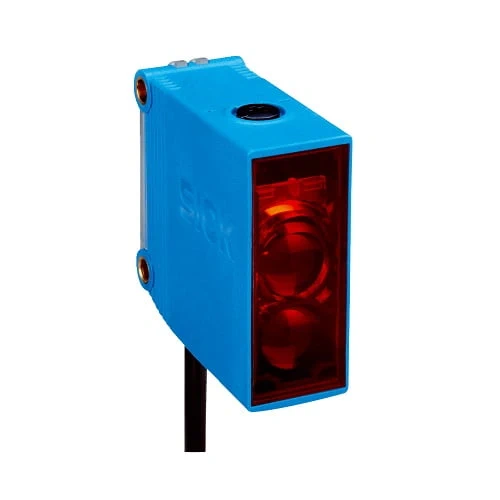
1. Monitoring accumulation at a conveyor transfer
A conveyor transfer can present an opaque load within the commissioned background-suppressed sensing distance. External sequencing logic reads the isolated relay state and evaluates how long the load remains at that position. Setup checks target remission, background geometry and dwell timing against the specified range, 10 ms response and 20 Hz switching conditions before coordinating upstream release.
Problem Solved
A sustained load-present state helps external sequencing logic manage accumulation at a transfer, using an isolated relay interface and a sensing distance checked for the actual load.
Transfer accumulation
Isolated relay
Background suppression
2. Counting separated loads through a guide
A guide can move separated opaque loads past the red optical sensing point and send relay transitions to an external counter. Commissioning sets the five-turn potentiometer for representative load surfaces and checks the darker-target ranges. Feed speed, load gaps and expected lifetime switching count are assessed against the response, switching-frequency and relay-endurance specifications.
Problem Solved
A discrete relay transition gives an external counter a load-passage event, using checked optical separation and operating rates compatible with the electromechanical output.
Load counting
Relay endurance
Range adjustment
3. Monitoring opaque material presence at a feed station
A feed station can place the sensor beside a stable opaque material path and set the sensing distance so a more distant machine surface is suppressed. Loss of material changes the relay condition for an external process circuit. Installation matches that circuit’s voltage and current to the specific relay limits and provides suitable suppression for an inductive or capacitive load.
Problem Solved
An isolated material-present contact helps an external process circuit recognize loss of feed at a defined location, using background suppression and a relay load matched to the installed circuit.
Feed presence
SPDT interface
Load suppression