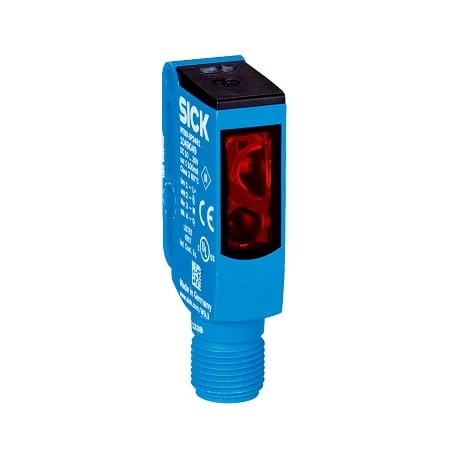
1. Confirming a component in an assembly nest
An assembly nest can present a component at a repeatable distance facing the sensor. Background suppression provides a switching condition from one mounting side, while the documented adjustment establishes detection for representative components. External inspection logic samples the output after the component settles. Setup verifies actual target reflectance, placement tolerance and background geometry before accepting the installed detection point.
Problem Solved
A component-present reference helps external inspection logic distinguish an occupied assembly location from an empty nest, using commissioned target geometry and the documented adjustment method.
Assembly presence
Background suppression
External inspection
2. Counting separated components on a guide
A component guide can move separated parts through the optical sensing point and send switching transitions to external counting electronics. Commissioning establishes the working gap and adjustment using representative materials, including the darkest expected target. Part transit time and gaps are checked against the documented response and switching-frequency conditions before setting the counting logic.
Problem Solved
A discrete optical passage signal helps external counting electronics register separated components, using a commissioned sensing point and timing conditions matched to the actual parts feed.
Part counting
Target reflectance
Timing checks
3. Confirming a carrier at its transfer stop
A transfer stop can bring a defined carrier surface into the sensor’s working distance. External sequencing logic reads the optical switching state after the carrier reaches its seated position. Setup uses the documented adjustment and verifies actual carrier reflectance, gap tolerance and background geometry, then confirms that the selected light/dark behavior matches the connected process input.
Problem Solved
A seated-carrier condition helps external sequencing logic coordinate the next transfer step, using a checked optical gap and switching behavior for the actual carrier surface.
Carrier arrival
Transfer stop
Process sequencing