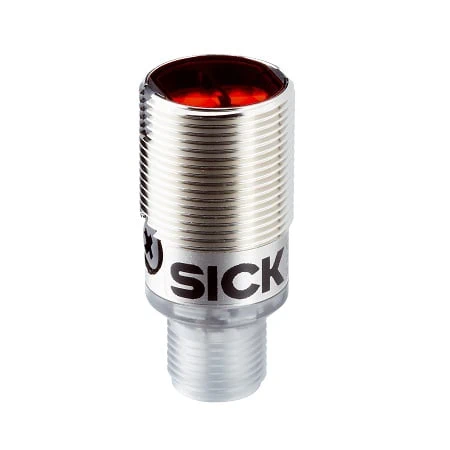
SICK 1069579 GRTE18S-P2442 PNP Energetic Photoelectric Sensor

USD 56.16

GRTE18S-P2442 offers 10–400 mm reference-white sensing, red PinPoint LED light, complementary PNP outputs, M18 metal housing and M12 four-pin connection.

SKU SICK-1069579 Category
SICK GR18S

SICK GRTE18S-P2442 PNP Energetic Photoelectric Sensor

BrandSICK
Model IdentifierGRTE18S-P2442
Official Part Number1069579

Technical Overview

The SICK GRTE18S-P2442 is a short axial energetic photoelectric proximity sensor with complementary PNP outputs. Reference-white sensing spans 10–400 mm, with a 5–550 mm maximum range and shorter ranges for gray and black targets. Its 650 nm red PinPoint LED produces a 9 mm spot at 400 mm, and a 270° potentiometer adjusts sensitivity. Response is below 1,000 µs with resistive load, with 500 Hz switching at a 1:1 light/dark ratio. The device uses 10–30 V DC and an M12 four-pin male connector. Its M18 × 1 nickel-plated brass/ABS housing has PMMA optics and IP67 protection. Two metal fastening nuts are supplied. Output current and ambient-temperature limits depend on supply voltage and loading.

Short M18 energetic sensor with 10–400 mm reference-white sensing, 270° sensitivity adjustment, complementary PNP outputs and M12 four-pin connector.

Key Features

  • Axial energetic photoelectric proximity sensing
  • 10–400 mm sensing; 5–550 mm maximum range on reference white
  • 650 nm red PinPoint LED; Ø9 mm spot at 400 mm
  • 270° sensitivity potentiometer
  • Complementary PNP outputs; light/dark switching
  • ≤100 mA output; maximum 50 mA above 24 V or above +49 °C ambient
  • <1,000 µs response with resistive load; 500 Hz at 1:1 light/dark ratio
  • 10–30 V DC; M12 four-pin male connector
  • M18 × 1 nickel-plated brass/ABS housing; PMMA optics; IP67
  • Two metal fastening nuts supplied; width across flats 24 mm

Adjust sensitivity for the presented target and feed complementary PNP signals to external control, using the axial M18 mounting arrangement.

Technical Specification Matrix

ParameterValue
Functional principleEnergetic photoelectric proximity sensor
Optical axisAxial
Sensing range10–400 mm on 90% remission reference white (DIN 5033)
Maximum sensing range5–550 mm on 90% remission reference white (DIN 5033)
Reference-target rangesSensing / maximum: white 90% 10–400 / 5–550 mm; gray 20% 15–170 / 10–250 mm; black 6% 20–90 / 15–120 mm
Light sourceVisible red PinPoint LED
Wavelength650 nm
Light spot sizeØ9 mm at 400 mm
LED service lifeAverage 100,000 h at ambient +25 °C
AdjustmentSensitivity potentiometer, 270°
Switching outputComplementary PNP outputs
Switching modeLight/dark switching
Output current≤100 mA; maximum 50 mA at supply voltage >24 V or ambient temperature >+49 °C
Response time<1,000 µs with resistive load
Switching frequency500 Hz at 1:1 light/dark ratio
Power supply10–30 V DC; limit values in a short-circuit-protected network, maximum 8 A
Ripple<5 Vpp; remain within supply tolerances
Current consumption30 mA
ConnectionM12 four-pin male connector
Pin assignment1 BN=L+; 2 WH=Q̅; 3 BU=M; 4 BK=Q
Circuit protectionA: supply reverse-polarity protection; B: inputs and output reverse-polarity protection; D: outputs overcurrent and short-circuit protection
Protection classIII
Housing materialNickel-plated brass and ABS
Optics materialPMMA plastic
Mounting threadM18 × 1
IP ratingIP67
Items suppliedTwo metal fastening nuts; width across flats 24 mm
IndicatorsGreen static on: power on; yellow static on: object present; yellow off: object not present
Operating temperature−25 to +55 °C at supply ≤24 V and output current <50 mA
Storage temperature−40 to +70 °C
EMCEN 60947-5-2
UL fileNRKH.E348498 and NRKH7.E348498

Industrial Applications

1. Confirming a component in an assembly fixture

An assembly fixture can present a component surface at a repeatable gap facing the axial optical head. Sensitivity is adjusted using representative parts, and external inspection logic reads a complementary PNP output after the component settles. Setup checks actual reflectance, placement tolerance and the empty-fixture response because energetic sensing depends on returned light from the presented target.

Problem Solved

A component-present reference helps external inspection logic distinguish an occupied fixture from an empty location, using sensitivity and geometry checked for the actual part surface.

Fixture inspection Energetic sensing PNP signals

2. Counting separated parts on a guide

A parts guide can move separated components through the sensor’s adjusted working gap and feed switching transitions to external counting electronics. Commissioning checks the darkest expected surface, part coverage and guide reflections with representative material. The feed speed and gaps are then checked against the documented response time and switching-frequency conditions before accepting passage events.

Problem Solved

A defined optical passage signal helps external counting electronics register separated parts, using an adjusted sensing point and timing checks for the actual parts feed.

Parts counting Reflectance checks Timing checks

3. Checking opaque strip continuity at a feed point

A material feed can keep a repeatable opaque strip surface within the adjusted energetic sensing gap while external process logic monitors its presence. Installation checks returned light from the actual strip, the empty path and nearby machine surfaces. Commissioning also verifies strip movement, gap tolerance and output loading so a missing strip produces a distinguishable process signal.

Problem Solved

A strip-presence reference helps external process logic recognize loss of feed at the checked location, using sensitivity and returned-light conditions established for the actual material path.

Strip continuity Material presence External process logic

Select your currency