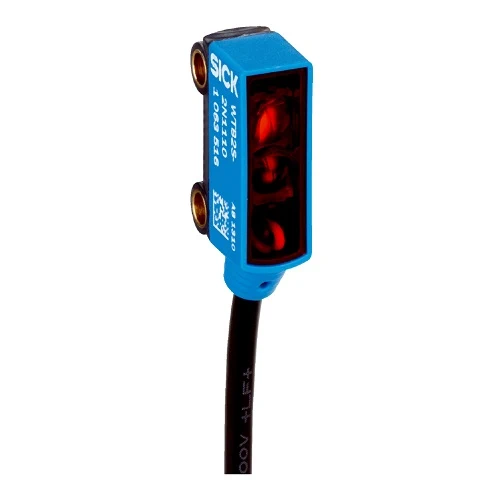
SICK 1064249 WTB2S-2N1310 Fixed-setting NPN Sensor

USD 111.02

WTB2S-2N1310 offers 3–15 mm reference-white sensing, 640 nm red PinPoint light, background suppression, fixed light switching and a 2 m three-wire cable.

SKU SICK-1064249 Category
SICK W2

SICK WTB2S-2N1310 NPN Background Suppression Sensor

BrandSICK
Model IdentifierWTB2S-2N1310
Official Part Number1064249

Technical Overview

The SICK WTB2S-2N1310 is a photoelectric proximity sensor with background suppression and fixed settings for small-object detection. The reference-white sensing range is 3–15 mm, with a 1–18 mm maximum range; typical background suppression starts from 20 mm. Its 640 nm red PinPoint LED produces a 2 mm spot at 8 mm. The NPN output uses fixed light switching, with no adjustment control. Response is below 0.4 ms with resistive load, with 1,200 Hz switching at a 1:1 light/dark ratio. The 10–30 V DC device has a 2 m three-wire PVC cable with 0.09 mm² conductors. An ABS/PC housing and PMMA optics provide IP67 protection.

Fixed-setting background suppression sensor with 3–15 mm reference-white sensing, NPN light switching and a 2 m three-wire PVC cable.

Key Features

  • Photoelectric proximity sensing with background suppression
  • 3–15 mm reference-white sensing; 1–18 mm maximum range
  • Typical background suppression from 20 mm
  • 640 nm red PinPoint LED; Ø2 mm spot at 8 mm
  • Fixed settings; no adjustment control; small-object detection design
  • NPN output; fixed light switching; ≤50 mA
  • <0.4 ms response with resistive load; 1,200 Hz at 1:1 light/dark ratio
  • 10–30 V DC; 20 mA without load
  • 2 m three-wire PVC cable; 0.09 mm² conductors; 3 mm diameter
  • ABS/PC housing; PMMA optics; IP67; −25 to +50 °C operation

Present small parts at a repeatable close gap and send a fixed light-switching NPN signal to external inspection or counting logic.

Technical Specification Matrix

ParameterValue
Functional principlePhotoelectric proximity sensor with background suppression
Sensing range3–15 mm on 90% remission reference white (DIN 5033)
Maximum sensing range1–18 mm on 90% remission reference white (DIN 5033)
Background suppressionTypical from 20 mm
Manufacturer applicationDetecting small objects
Light sourceVisible red PinPoint LED
Wavelength640 nm
Light spot sizeØ2 mm at 8 mm
LED service lifeAverage 100,000 h at ambient +25 °C
AdjustmentNone; fixed settings
Switching outputNPN
Switching modeFixed light switching
Output current≤50 mA
Response time<0.4 ms with resistive load
Switching frequency1,200 Hz at 1:1 light/dark ratio
Power supply10–30 V DC; limit values
Ripple<5 Vpp; remain within supply tolerances
Current consumption20 mA without load
Connection2 m three-wire PVC cable; do not bend below 0 °C
Cable conductors0.09 mm² cross-section; 3 mm cable diameter
Wire assignmentsCD-044: BN=L+; BU=M; BK=Q
Circuit protectionA: supply reverse-polarity protection; B: output reverse-polarity protection; D: outputs overcurrent and short-circuit protection
Housing materialABS/PC plastic
Optics materialPMMA plastic
IP ratingIP67
Mounting3.2 mm diameter mounting holes
IndicatorsGreen: supply voltage active; yellow: received-light status
Operating temperature−25 to +50 °C
Storage temperature−40 to +75 °C
UL fileNRKH.E181493
MTTFD3,378 years
DCavg0%

Industrial Applications

1. Checking a small component in an assembly fixture

An assembly fixture can hold a small component at a repeatable close gap facing the red optical head. External inspection logic samples the fixed light-switching NPN signal after the part settles. Commissioning checks actual target remission, coverage, placement tolerance and the empty fixture because the fixed settings must suit the installed part and background geometry.

Problem Solved

A component-present reference helps external inspection logic distinguish a loaded fixture from an empty position, using a fixed sensing gap checked with the actual component surface.

Fixture inspection Fixed settings NPN output

2. Counting separated small parts along a guide

A parts guide can carry separated components through the fixed close sensing point while external counting electronics register output transitions. Setup checks actual part coverage and reflectance without relying on a sensitivity control. Feed speed and the gaps between successive components are checked against the resistive-load response time and the specified light/dark switching-frequency conditions.

Problem Solved

A defined optical passage event helps an external counter register separated small parts, using a fixed sensing position and timing checks for the actual guide and feed speed.

Small-part counting Close sensing Timing checks

3. Monitoring opaque strip continuity at a feed point

A feed mechanism can hold an opaque strip within the fixed close sensing range and use its normal surface to establish a material-present signal. External process logic recognizes loss of the strip from the NPN state. Commissioning checks flutter, lateral movement, surface remission and the empty-path background so normal feed remains distinguishable throughout the installed movement tolerance.

Problem Solved

A strip-presence reference helps external process logic recognize loss of opaque feed at the checked location, using fixed optics and geometry verified for the actual material path.

Strip continuity Fixed sensing Process input

Select your currency