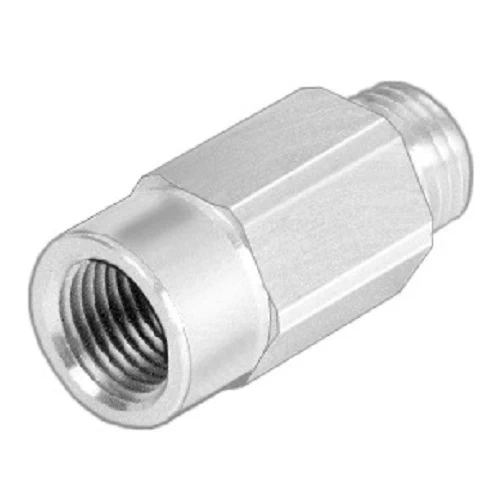
1. Parallel Suction Heads with Unoccupied Cups
A handling tool uses several suction cups in parallel, but the workpiece does not cover every cup position. The ISV valve closes the air-inflow path at an uncovered or partly covered cup, limiting its effect on the shared vacuum circuit. The M5 version has a documented 1 l/min required suction flow at −0.5 bar, which is relevant when sizing the generator for the parallel branches.
Problem Solved
Automatic branch shutoff limits the air drawn through unoccupied cups, supporting vacuum generation at the cups that make full contact rather than leaving every open branch unrestricted.
Automatic branch shutoff
M5
1 l/min at −0.5 bar
2. Branch Isolation When a Workpiece Leaves a Cup
During a transfer or release sequence, one suction cup can become open to atmosphere while other cups remain connected to a shared vacuum source. Festo describes the ISV closing when a workpiece separates from the cup. Installing the 4 g M5 valve at the individual branch provides this local automatic response without requiring a separate electrical command at that cup.
Problem Solved
The valve automatically restricts the newly opened branch when the workpiece separates, limiting an uncontrolled air-inflow path into the shared vacuum circuit during the sequence.
Automatic local response
4 g
Screw-in mounting
3. Vacuum Branch Incorporating an Ejector Pulse
A suction-handling circuit uses a positive-pressure ejector pulse as part of its release process while retaining a vacuum security valve at the cup branch. The ISV-M5 is documented as suitable for an ejector pulse up to 8 bar, distinct from its −0.95 to 0 bar vacuum operating range. Its M5 screw-in interfaces provide the connection arrangement for that combined circuit.
Problem Solved
Documented ejector-pulse compatibility lets the branch include the valve's automatic vacuum-isolation function alongside a release pulse, with the pulse and vacuum pressure limits kept distinct.
Up to 8 bar ejector pulse
−0.95 to 0 bar vacuum
M5