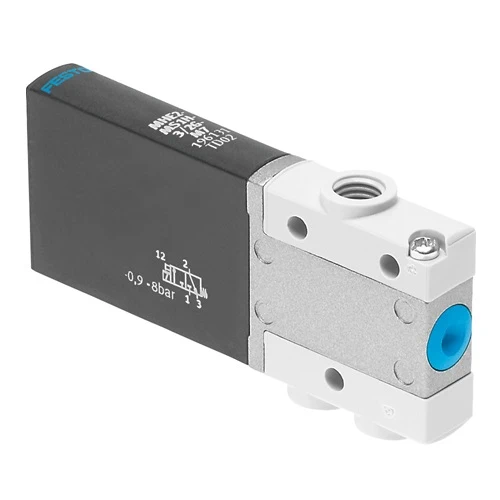
1. Timed Air Pulses at a Process Nozzle
A production station needs electrically timed air pulses at a small pneumatic nozzle. The valve's 3/2 normally closed function and mechanical spring reset provide electrically commanded flow switching, with 7 ms on and 3.5 ms off component times. Its 100 l/min nominal flow and M7 ports characterize the selected pneumatic capacity, while the 130 Hz maximum switching frequency defines a component limit rather than a guaranteed nozzle pulse rate.
Problem Solved
The direct valve provides a documented electrical-to-pneumatic switching element for timed air delivery, with explicit switching-time and flow data for evaluating the pulse circuit.
7 ms on / 3.5 ms off
130 Hz maximum
100 l/min
2. Control of a Single-Acting Fixture Actuator
A fixture uses a single-acting pneumatic mechanism that needs an electrical command to pressurize its working line and a valve return state when the coil is de-energized. The 3/2 normally closed design supplies the corresponding directional function, with mechanical spring reset. A 24 V DC two-pin connection interfaces with the machine wiring, and the 100% duty rating permits continuous coil energization within the specified conditions.
Problem Solved
The three-port directional function and spring reset provide the valve states needed for an electrically commanded single-acting circuit, with a documented continuous-duty coil rating.
3/2 normally closed
Mechanical spring
24 V DC
3. Direct Switching of a Vacuum Branch
A vacuum-handling branch needs an electrically actuated valve without relying on a separate pilot-air pressure differential. The MHE2 uses direct actuation and has a documented negative-pressure operating range down to −0.9 bar. Flow reversal is permitted only with restrictions and a separate −0.9 to 1 bar range, so the vacuum circuit arrangement must follow that documented distinction rather than treating the valve as unrestricted in either direction.
Problem Solved
Direct actuation supplies electrical switching for the negative-pressure circuit, while the explicit normal and reversed pressure ratings define the supported pneumatic arrangement of the branch.
Direct actuation
−0.9 bar capability
Restricted reversal