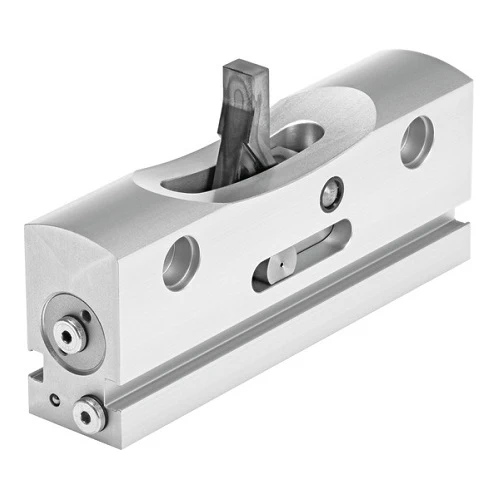
1. Serving an Intermediate Assembly Station
A pneumatic mini slide must present its carried component at a working location between the normal stroke endpoints. The module adds a swivelled stop lever beside the slide, contacted through the separately required retainer and cushioning component. Its ±0.02 mm repetition accuracy characterizes the intermediate-position function, while the 1100 N maximum stop force provides an explicit mechanical limit for assessing the arrangement.
Problem Solved
An additional stop position lets the existing slide serve an intermediate process location, with the active lever and cushioned contact arrangement defining how that position is established.
Intermediate stop
±0.02 mm repetition
1100 N maximum stop force
2. Selecting Intermediate Stop or Continued Travel
A transfer sequence sometimes uses the intermediate station and sometimes needs to continue along the slide path. Pneumatic connections swivel the stop lever inward or outward, and Festo documents through-travel and direct continuation from the intermediate position. The M5 interface, 3–6 bar range and 150 ms maximum swivel time supply relevant control parameters for coordinating that selection with slide movement.
Problem Solved
A retractable stop lever allows the sequence to select the intermediate position or continue travel, adding route flexibility without making the stop a permanent obstruction.
Retractable stop lever
M5 pneumatic control
150 ms maximum swivel
3. Checking Stop-Lever Readiness before Slide Motion
A machine controller needs to know whether the intermediate stop lever is engaged or withdrawn before issuing the next slide command. The module supports proximity-switch detection of lever position, providing a documented sensing point at the mechanism. Through-hole and centring-sleeve mounting locate the module beside the compatible slide, keeping the observed stop state associated with the selected intermediate-position arrangement.
Problem Solved
Lever-position detection supplies feedback about the stop's mechanical state, supporting sequence coordination based on the observed mechanism rather than the pneumatic command alone.
Proximity-switch detection
Engaged/withdrawn lever
Centring-sleeve mounting