Sale!

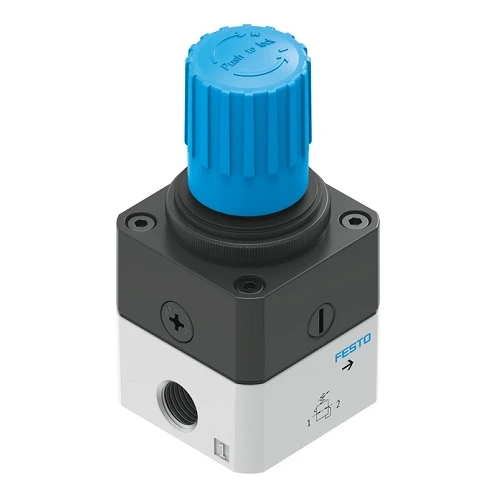
Festo 159502 Precision Pressure Regulator, 0.1–10 bar, G1/4

Original price was: USD 71.24.Current price is: USD 61.88.

Piloted diaphragm regulator with 0.1–10 bar adjustment, 0.02 bar maximum hysteresis, secondary exhausting, G1/4 ports and 2300 l/min nominal flow.

SKU Festo-159502 Category
Festo Pressure Regulator

Festo LRP-1/4-10 Precision Pressure Regulator

BrandFesto
Model IdentifierLRP-1/4-10
Official Part Number159502

Technical Overview

The Festo LRP-1/4-10 is a piloted precision diaphragm regulator providing constant output pressure over a 0.1–10 bar adjustment range. Maximum pressure hysteresis is specified as 0.02 bar, with 2300 l/min standard nominal flow and a 1–12 bar inlet-pressure range. Secondary exhausting provides a relief path on the regulated side, while a detented rotary knob forms the adjustment interface. The aluminium-bodied unit has G1/4 inlet and outlet connections and a prepared G1/8 gauge connection. It supports unlubricated compressed air or inert gas, front-panel or inline mounting, and −10 to 60 °C media and ambient temperatures.

G1/4 precision diaphragm regulator with 0.1–10 bar adjustment, 0.02 bar maximum hysteresis and secondary exhausting.

Key Features

  • 0.1–10 bar pressure-regulation range
  • 0.02 bar maximum pressure hysteresis
  • Piloted precision diaphragm control-valve design
  • Constant output pressure with secondary exhausting
  • 2300 l/min standard nominal flow to DIN 1343
  • 1–12 bar inlet-pressure range
  • G1/4 inlet and outlet; prepared G1/8 pressure-gauge connection
  • Rotary knob with detent; front-panel, inline or accessory mounting
  • Unlubricated compressed air and inert-gas operating media
  • 310 g product weight with aluminium housing and NBR seals

Adjust pneumatic working pressures from 0.1 to 10 bar with a precision diaphragm regulator specified for 0.02 bar maximum hysteresis.

Technical Specification Matrix

ParameterValue
Actuator lockRotary knob with detent
Mounting positionAny
DesignPiloted precision diaphragm control valve
Controller functionOutput pressure constant; With secondary exhausting
Pressure gauge (ANALOG) or Pressure display (DIGITAL)Prepared for G1/8
Operating pressure0.1 MPa...1.2 MPa; 1 bar...12 bar
Pressure regulation range0.1 bar...10 bar
Inlet pressure 11 bar...12 bar
Max. pressure hysteresis0.02 bar
Standard nominal flow rate (standardised to DIN 1343)2300 l/min
Operating mediumCompressed air to ISO 8573-1:2010 [7:4:4]; Inert gas
Note on operating and pilot mediumLubricated operation not possible
LABS (PWIS) conformityVDMA24364-B1/B2-L
Media temperature-10 °C...60 °C
Ambient temperature-10 °C...60 °C
Physical Weight (kg)0.31
Type of mountingFront panel mounting; Inline installation; With accessories
Pneumatic connection, port 1G1/4
Pneumatic connection, port 2G1/4
Note on materialsRoHS compliant
Material sealsNBR
Material housingAluminium

Industrial Applications

1. Pressure Setting for a Light Clamping Fixture

A pneumatic assembly fixture needs a reduced working pressure for handling parts that require a light clamp setting. The 0.1–10 bar regulation range provides low-pressure adjustment at the fixture branch, while the piloted diaphragm design maintains the output-pressure function. The specified 0.02 bar maximum hysteresis characterises the regulator's pressure-setting behaviour without implying a complete fixture force-accuracy rating.

Problem Solved

Local pressure reduction provides the clamp circuit with a suitable adjustment range, while the documented hysteresis helps characterise the regulator response during changes to the working-pressure setting.

0.1–10 bar 0.02 bar maximum hysteresis G1/4 ports

2. Lowering a Test-Line Pressure Between Recipes

A pneumatic test station changes its downstream pressure between test recipes. The regulator's secondary-exhausting function gives the regulated side a relief path when the setpoint is reduced. A detented rotary knob provides manual adjustment, and the prepared G1/8 connection allows a separately selected pressure gauge to be incorporated into the test-line arrangement.

Problem Solved

Secondary exhausting allows retained downstream pressure to decrease during a lower setpoint adjustment, supporting recipe changes through the same regulator used to establish the test pressure.

Secondary exhausting Detented knob G1/8 gauge preparation

3. Regulated Inert-Gas Feed to a Process Fixture

A process fixture requires a reduced-pressure inert-gas feed rather than a direct connection to the upstream line. Festo lists inert gas as an operating medium for this regulator, alongside unlubricated compressed air. The G1/4 ports connect the regulated branch, and the 1–12 bar inlet and 0.1–10 bar output-setting ranges define its pressure-control envelope.

Problem Solved

The regulator provides documented inert-gas pressure-reduction capability at the fixture feed, combining a defined input-pressure range with local output adjustment in one diaphragm-controlled component.

Inert-gas medium 1–12 bar inlet 0.1–10 bar regulation

Select your currency