1. Pallet Arrival at a Conveyor Workstation
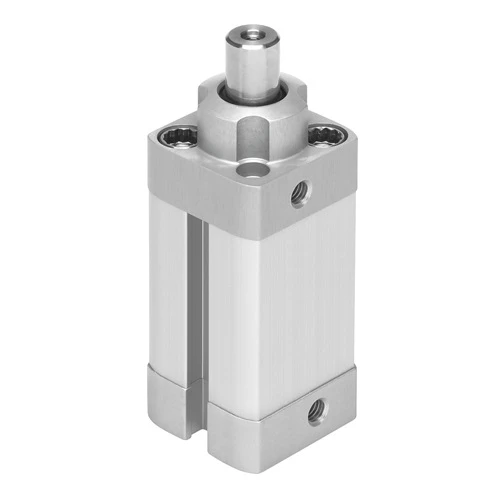
A conveyor workstation needs a mechanical stop for an arriving workpiece carrier. The round trunnion rod presents the stopping interface, while the cylinder’s 10 mm stroke provides withdrawal travel. The 1370 N impact rating applies to force on the extended rod; permissible carrier mass depends on speed, buffering and the manufacturer’s mounting conditions, rather than that force alone.
Problem Solved
The raised trunnion rod provides a stopping interface and retracts to release the carrier, supporting controlled workstation entry within the documented impact, mounting and conveyor-loading conditions.
Female-threaded trunnion rod
10 mm stroke
1370 N impact rating
2. Release from a Continuing Conveyor Load
A conveyor may continue applying a lateral friction load after a carrier has stopped. The double-acting, spring-equipped cylinder withdraws its round trunnion rod, with lateral switching force specified separately from impact force. Its 228 N permissible lateral switching force is evaluated after impact, and the manufacturer’s guidance links this condition to the available pneumatic pressure and mounting arrangement.
Problem Solved
Separating the withdrawal load from the arrival impact supports a stop-release mechanism based on the relevant lateral switching condition, while the spring-equipped pneumatic drive supplies the rod movement.
Spring-equipped drive
M3 female rod thread
Lateral switching load
3. Position-Confirmed Transfer-Line Sequencing
A transfer line needs to coordinate a carrier-release command with the stopper’s actual piston position. This cylinder supports proximity-switch detection to observe its 10 mm travel. The controller can use compatible switch inputs to distinguish extended and withdrawn conditions, while the documented 5 Hz maximum cycle frequency defines a component limit for sequence planning.
Problem Solved
Position-detection capability provides feedback from the cylinder movement, allowing the transfer sequence to coordinate release with the observed piston position instead of relying only on a timed command.
Proximity-switch detection
10 mm stroke
5 Hz maximum