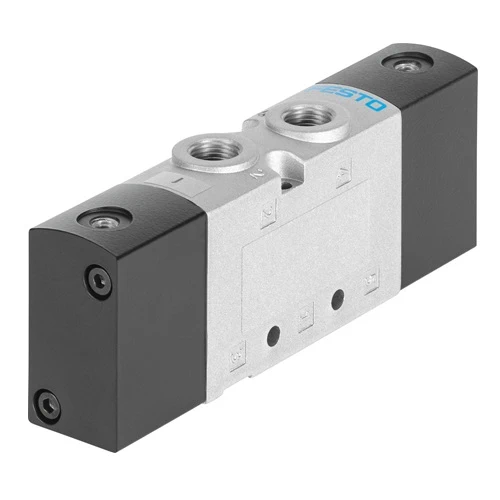
1. Two-Signal Transfer-Cylinder Control
An assembly machine uses separate pneumatic signals to command the two directions of a double-acting transfer cylinder. The bistable 5/2-way valve alternates pressure and exhaust between G3/8 working connections, with pilot ports 12 and 14 receiving the air commands. Its 2300 l/min nominal flow characterizes the valve selected for the transfer circuit.
Problem Solved
Separate air-command ports select the two directional states through one bistable valve, providing the pressure-and-exhaust routing needed for the transfer cylinder’s extension and retraction.
5/2-way bistable
G1/8 pilot ports
G3/8 working ports
2. Pneumatically Sequenced Gripper Control
A handling unit commands a double-acting pneumatic gripper using an existing air-signal sequence. This valve routes the gripper’s two working lines through its bistable 5/2-way function, with pneumatic commands at the two G1/8 pilot ports. Manifold-rail mounting groups the gripper control with adjacent functions, and the 1.5–10 bar pilot range defines the command-air requirement.
Problem Solved
Pneumatic directional switching connects the gripper’s two working lines through one component, while manifold mounting groups the bistable control with the handling unit’s other air-command functions.
Pneumatic actuation
1.5–10 bar pilot
Manifold mounting
3. Two-Position Conveyor Diverter
A conveyor uses a pneumatic actuator to move a diverter between two product routes. The valve selects the actuator’s working-air connections through its bistable 5/2-way function, with a specified 13 ms reversal time. The G3/8 working ports and 2300 l/min nominal flow provide component data for evaluating the pneumatic arrangement alongside the actuator and tubing response.
Problem Solved
The valve supplies directional air routing for the diverter, while the documented reversal time and nominal flow give concrete component data for arranging the pneumatic route commands.
13 ms reversal
2300 l/min nominal
5/2-way bistable