1. End-of-Travel Impact Cushioning on a Transfer Mechanism
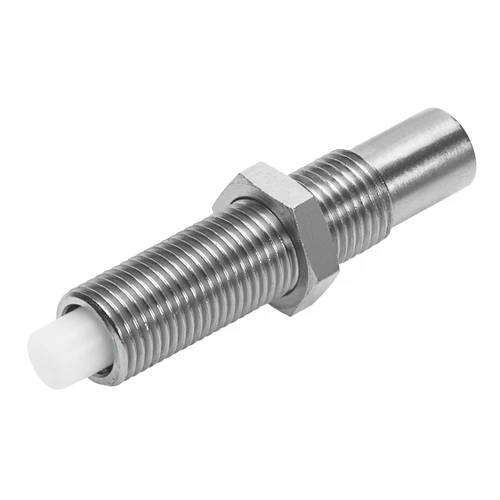
A transfer mechanism brings a moving attachment against an end-of-travel cushioning element. The DYSC operates in the pushing direction with self-adjusting cushioning over 12 mm, a 10 J maximum per-stroke energy rating and a 3 m/s maximum impact speed. Those separate specifications characterize the selected shock absorber for evaluating the mechanism's actual moving energy and contact arrangement.
Problem Solved
The self-adjusting cushioning stroke provides a defined component for absorbing end-of-travel impact energy, with explicit stroke, energy and speed limits for the moving mechanism.
12 mm cushioning
10 J per stroke
3 m/s maximum
2. Repeated Indexing with an Hourly Energy Budget
A machine repeatedly indexes a mechanism into a cushioned endpoint and needs to evaluate accumulated impact energy as well as each individual hit. This model specifies 36000 J maximum energy per hour separately from the 10 J per-stroke maximum. Its 0.2 s room-temperature reset time adds a documented return characteristic, while actual cycle frequency must also respect the complete load and temperature conditions.
Problem Solved
Separate stroke and hourly energy ratings provide a basis for assessing repeated impacts, preventing a single-hit capacity from being treated as an unlimited repeated-cycle rating.
36000 J per hour
10 J per stroke
0.2 s room-temperature reset
3. Cold-Environment Stop Reset Planning
A pneumatic mechanism starts in a low-temperature machine area and needs the shock absorber to reset before the next pushing contact. The DYSC is specified down to −10 °C, but its reset time increases from 0.2 s at room temperature to 1 s at the minimum ambient temperature. Lock-nut mounting and any-position installation provide the documented mechanical arrangement for that cushioning point.
Problem Solved
The temperature-specific reset rating gives the machine sequence a defined cold-condition constraint, helping prevent the next impact from being commanded before the absorber has returned.
−10 °C minimum ambient
1 s cold reset
Lock-nut mounting