1. Compact Component Ejection
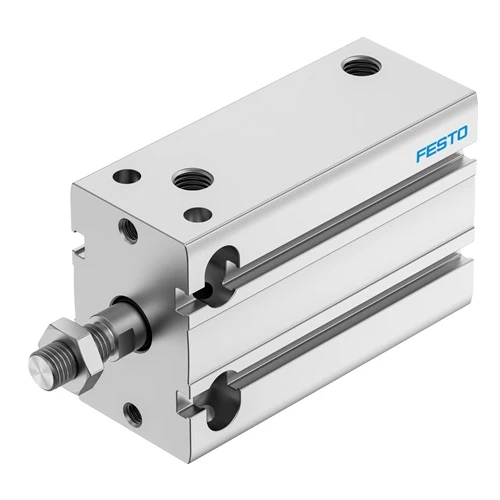
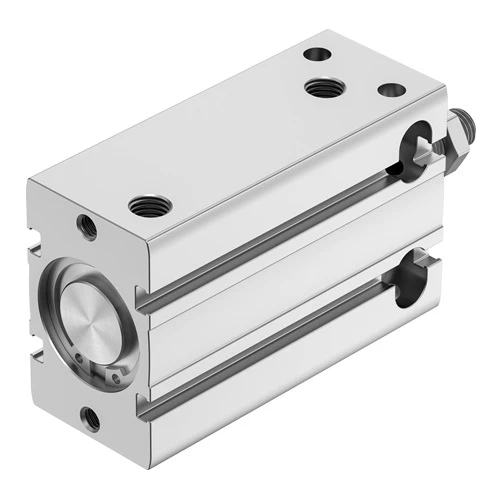
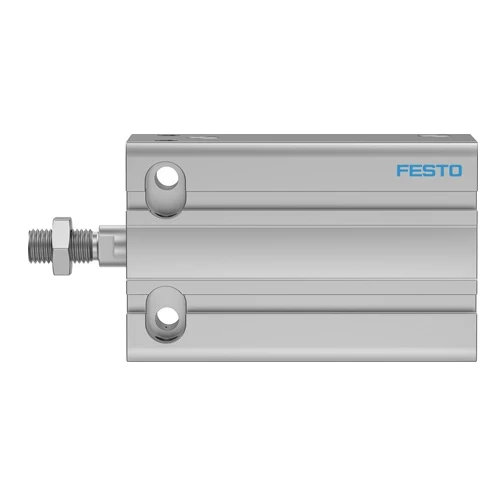
An assembly fixture needs to push a released component clear of its nest and retract the attachment for the next cycle. The 50 mm stroke supplies the documented travel, while double-acting operation powers both movements. Theoretical advance and return forces of 483 N and 415 N at 6 bar characterize the two pneumatic actions, with elastic cushioning at the stroke ends.
Problem Solved
Powered movement in both directions provides an advancing ejection action and a positive return stroke, with a defined stroke length and documented theoretical force for the mechanism.
50 mm stroke
Double-acting
483 N at 6 bar
2. Position-Confirmed Stop Retraction
A machine retracts a mechanical stop before allowing the next assembly movement. This cylinder supports proximity-switch position detection, giving the controller a means of observing actuator position in the sequence. Elastic cushioning acts at the travel ends, while double-acting operation provides powered movement and the G1/8 ports connect the pneumatic working lines.
Problem Solved
Proximity-switch compatibility supports position confirmation before the machine proceeds, while double-acting travel provides the pneumatic movement needed to extend and retract the stop.
Proximity-switch detection
Elastic cushioning
G1/8 ports
3. Short-Travel Fixture Clamping
An assembly fixture needs a short pneumatic movement to bring a suitable clamping attachment onto a workpiece. The 32 mm piston and 50 mm stroke provide the actuation geometry, with 483 N theoretical advance force at 6 bar. Through-hole or female-thread mounting connects the cylinder to the fixture structure, while the actual clamping force depends on the attachment mechanism and installed pneumatic conditions.
Problem Solved
The compact cylinder supplies a powered clamping movement with documented stroke and theoretical force, giving the fixture a defined actuator basis without assuming a guaranteed workpiece holding load.
50 mm travel
483 N theoretical at 6 bar
Through-hole mounting