1. Adding emergency-stop input circuits
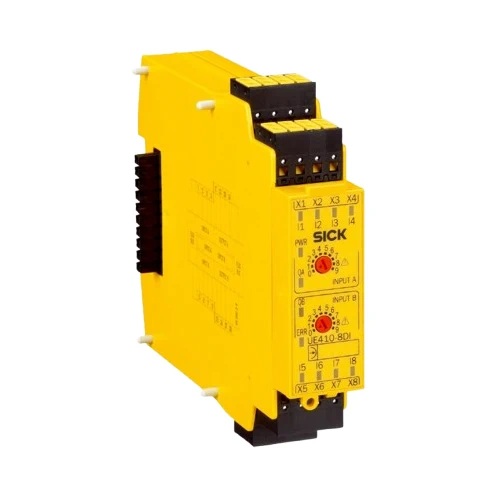
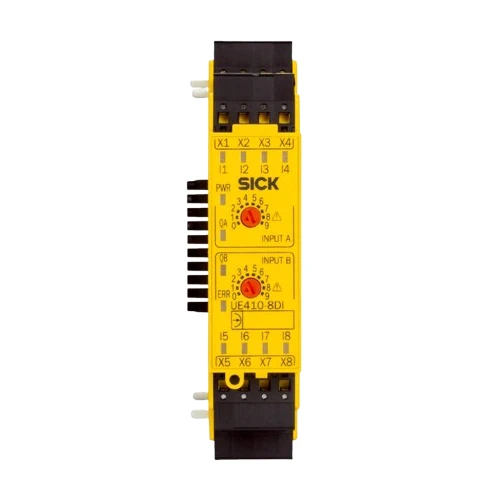
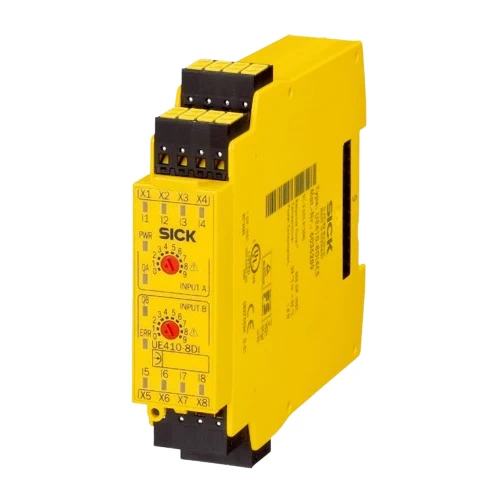
A machine designer can expand a Flexi Classic arrangement with emergency-stop input circuits and associated test signals. SICK’s sBot Stop example uses UE410-8DI4 inputs I1–I4 for emergency-stop circuits and X1–X4 for test pulses. The complete design establishes the selected rotary configuration, channel assignment and main-module stopping response, then validates those functions with the installed emergency-stop devices.
Problem Solved
Additional input channels and associated test signals give the configured safety system a means to evaluate emergency-stop demands from several locations within the validated machine arrangement.
Emergency-stop circuits
Input expansion
Test outputs
2. Integrating a scanner protective-field signal
A guarded robot-area arrangement can connect a compatible safety laser scanner’s OSSDs to the input expansion module as part of the complete protective-stop design. SICK’s sBot Stop example assigns these signals to I5 and I6. The system designer establishes scanner configuration, input evaluation and the main-module output response, then validates intrusion response and restart behavior for the installed arrangement.
Problem Solved
Scanner OSSD evaluation supplies the configured safety system with a protective-field condition, helping initiate the engineered protective-stop response when the monitored area requires it.
Scanner OSSDs
Protective-field evaluation
Flexi Classic integration
3. Combining several input conditions in control logic
A machine safety-control design can use the module’s AND/OR functions to combine several connected input conditions within the Flexi Classic arrangement. Rotary-switch selection establishes the intended relationship, while the main-module system provides the resulting safety outputs. Commissioning exercises the relevant input combinations and verifies that the configured logic produces the intended response, including restoration of permissive conditions.
Problem Solved
Configured input combination gives the complete control design a defined relationship between several input conditions and its response, helping avoid unintended permission from an incorrect signal combination.
AND/OR logic
Input combination
Rotary configuration