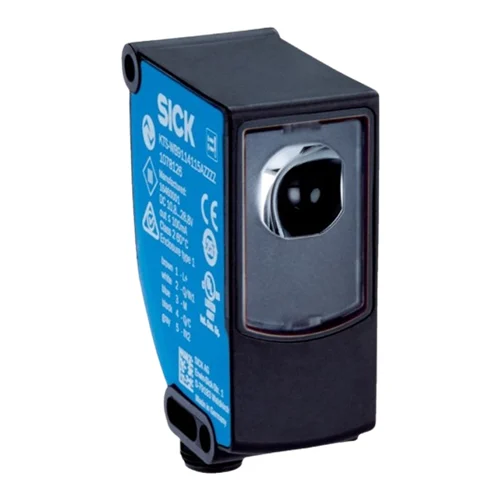
1. Registering a print mark for a cutting sequence
A packaging feeder can present a printed mark and its background beneath the long-side optical spot and teach their contrast using two-point mode. The NPN transition feeds external registration logic, which coordinates the downstream cut from measured material travel. Commissioning establishes sensing distance, mark coverage and feed timing using the 12.5 kHz rating and documented jitter for the selected mode.
Problem Solved
A taught print-mark transition gives external cutting control a material-registration reference, helping align the cut sequence with printed features rather than relying solely on elapsed feed time.
Print registration
Two-point teaching
NPN switching
2. Checking a presented color condition
A component-inspection fixture can present a colored surface at a repeatable distance and use one-point color mode to establish the required condition. The NPN result feeds external inspection logic after the part settles. Setup verifies actual color contrast, surface presentation and the ≤13 mm sensing distance, using the one-point mode’s 4 kHz switching and 60 µs jitter limits.
Problem Solved
A taught color condition gives external inspection logic a switching reference for checking presented components, helping identify a surface that differs from the established production reference.
Color test
One-point mode
Fixture inspection
3. Detecting a contrasting splice in a material web
A web-handling station can aim the sensor at a contrasting splice or splice marker and teach its optical condition against the surrounding material in two-point mode. External web-control logic evaluates the NPN event and applies the intended splice-handling sequence. Commissioning verifies actual contrast, standoff, web stability and marker duration against the configured switching and jitter limits.
Problem Solved
A contrasting-splice event gives external web control a reference for coordinating splice handling, helping distinguish the splice region from normal material passing through the sensing point.
Splice event
Web control
Contrast transition