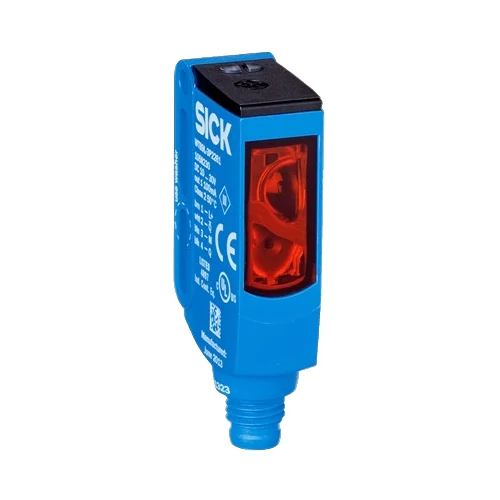
1. Checking a small component in a presentation fixture
A fixture can present a small opaque component near the adjusted sensing point and use a complementary NPN signal for external inspection logic. The 1 mm laser spot at 170 mm helps place the optical reference, while background suppression separates the intended target from more distant surfaces. Commissioning verifies actual component coverage, remission, background position and the selected working distance.
Problem Solved
A defined optical sensing point gives external inspection logic a component-presentation reference, helping identify an omitted or displaced target while limiting responses from more distant fixture surfaces.
Small component
Laser spot
Background suppression
2. Counting separated features on a moving carrier
A carrier can move separated opaque features through the adjusted sensing point and feed NPN transitions to external counting electronics. The controller counts passages after commissioning verifies feature coverage, target reflectance and spacing. Motion timing accounts for the ≤0.5 ms resistive-load response and 1,000 Hz rating, while the selected sensing distance respects the target-dependent range.
Problem Solved
Repeated optical transitions give external counting logic a passage reference for carrier features, helping register motion events using actual target movement through the installed sensing point.
Feature counting
1,000 Hz
Optical transition
3. Comparing complementary signals during fixture diagnostics
A fixture can connect Q and complementary Q̅ to two ordinary controller inputs and compare their settled states during a commanded presentation cycle. The NPN light/dark outputs provide opposing signals from the same optical condition. External diagnostic logic checks the expected relationship after transitions settle and records inconsistent input observations for maintenance, without treating this comparison as a safety function.
Problem Solved
Complementary observations give external maintenance logic a basis for identifying an unexpected input relationship, helping separate a normal optical transition from a wiring or input-reading inconsistency.
Complementary outputs
Fixture diagnostics
External comparison