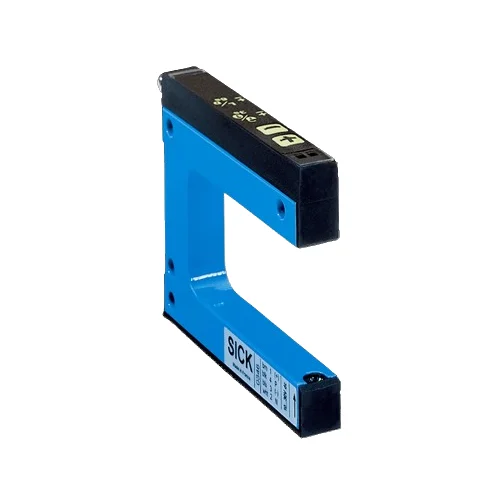
SICK 6028435 WF120-40B410 Optical Fork Sensor

USD 310.44

WF120-40B410 provides a 120 mm optical fork, 42 mm fork depth, 0.2 mm minimum detectable object, manual adjustment, PNP/NPN outputs and M8 connection.

SKU SICK-6028435 Category
SICK WF

SICK WF120-40B410 Optical Fork Sensor

BrandSICK
Model IdentifierWF120-40B410
Official Part Number6028435

Technical Overview

The SICK WF120-40B410 is an infrared LED optical fork sensor with a 120 mm fork width and 42 mm fork depth. It detects interruptions between its opposed optical elements and has a specified minimum detectable object of 0.2 mm. Plus/minus buttons adjust sensitivity, light/dark switching and key lock, with local indicators assisting setup. Separate NPN and PNP outputs connect through a four-pin M8 male connector. The 10 kHz switching rating, response no greater than 100 µs and separately stated response stability and jitter support timing assessment for moving targets. Its aluminum housing provides IP65 protection, operates on 10–30 V DC and has an operating temperature range of −20 to +60 °C.

Infrared optical fork sensor with 120 mm opening, 42 mm fork depth, manual sensitivity adjustment, 10 kHz switching and separate NPN/PNP outputs.

Key Features

  • 120 mm fork width and 42 mm fork depth
  • Infrared LED optical detection; minimum detectable object 0.2 mm
  • Label detection listed by the manufacturer
  • Manual plus/minus sensitivity adjustment, light/dark selection and key lock
  • Separate NPN and PNP outputs on the four-pin M8 connection
  • 10 kHz switching; response ≤100 µs
  • Response stability ±20 µs and jitter 40 µs, specified separately
  • 10–30 V DC; 40 mA consumption; 100 ms initialization
  • Aluminum housing; IP65; Ø4.2 mm mounting holes
  • −20 to +60 °C operation; ambient light immunity ≤10,000 lx

Use the opposed optics of a 120 mm fork to detect material interruptions, with local sensitivity adjustment and separate NPN and PNP connection signals.

Technical Specification Matrix

ParameterValue
Functional principleOptical fork sensing with infrared LED
Fork width120 mm
Fork depth42 mm
Minimum detectable object0.2 mm
Label detectionManufacturer lists label-detection capability
AdjustmentPlus/minus buttons: sensitivity, light/dark switching and key lock
Teach-in modeNone
Switching modeLight/dark switching selected by button
Switching outputsSeparate NPN and PNP outputs
NPN signal voltageHIGH approximately supply voltage; LOW ≤2 V
Output current100 mA
Switching frequency10 kHz
Response time≤100 µs
Response stability±20 µs
Jitter40 µs
Power supply10–30 V DC
Ripple<10%
Current consumption40 mA
Initialization time100 ms
ConnectionM8 four-pin male connector
Pin assignmentCD-086: 1 BN=L+; 2 WH=Q NPN; 3 BU=M; 4 BK=Q PNP
Circuit protectionSupply reverse-polarity protection; output Q short-circuit protection; interference pulse suppression
Protection classIII; reference voltage 50 V DC
Housing materialAluminum
IP ratingIP65
Mounting holesØ4.2 mm
IndicationYellow switching-output indicator; red function indicator
Manual sensitivity procedureClear beam: increase sensitivity with plus if needed for optimum received-light indication; object in beam: reduce with minus if needed
Operating temperature−20 to +60 °C
Storage temperature−30 to +80 °C
Ambient light immunity≤10,000 lx
Shock resistanceEN 60068-2-27
UL fileNRKH.E191603
MTTFD97 years
DCavg0%

Industrial Applications

1. Counting separated thin opaque parts through a wide fork

A transport mechanism can move separated opaque tabs or thin parts through the fork beam and feed switching transitions to an external counter. The 120 mm opening accommodates the material path, while the 0.2 mm minimum detectable object defines the stated small-target capability. Commissioning verifies beam coverage and spacing, and evaluates motion timing against the 10 kHz rating, response stability and jitter.

Problem Solved

Beam interruptions give the external counter discrete part-passage events, helping count separated targets with opposed optics already aligned within the same fork housing.

Thin-part counting 120 mm fork 10 kHz

2. Registering label gaps on a moving carrier web

A labeling machine can guide its carrier web through the fork and use optical transitions between labels and gaps as a registration reference. Manual sensitivity adjustment adapts detection to the actual label and backing transmission, while light/dark selection sets the required output logic. External feed control uses the selected NPN or PNP signal and assesses speed against the documented timing characteristics.

Problem Solved

A label-to-gap optical transition provides external feed control with a registration event, helping position successive labels using the contrast produced by the actual web materials.

Label registration Manual sensitivity Light/dark selection

3. Detecting a material edge crossing a fixed web threshold

A web-handling station can place the opposed optical elements across a fixed edge threshold so that lateral material movement blocks or clears the beam. The 42 mm fork depth provides access from the material edge, and the 120 mm opening accommodates the intended path. External logic interprets the selected switching state as a threshold crossing after setup verifies opacity and installed geometry.

Problem Solved

A fixed optical threshold converts edge movement into a switching condition for external web logic, helping identify when material crosses the selected lateral reference.

Web-edge threshold 42 mm depth Opposed optics

Select your currency