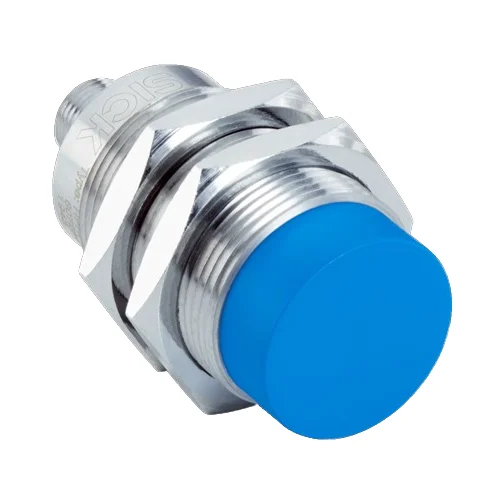
1. Reading a carrier identifier before a routing decision
A transfer station can position one tagged carrier beside the integrated HF antenna and pass its read data to external routing logic over IO-Link. The controller associates the identifier with its production order and selects the next route. Fixture design aligns the transponder plane parallel to the antenna and establishes the actual working gap using the chosen tag and surrounding metal.
Problem Solved
RFID identification gives external routing logic a carrier reference for associating a moving load with its production order before selecting a downstream destination.
Carrier routing
HF RFID
IO-Link data
2. Writing a process result to a reusable production carrier
After a station completes an operation, external production logic can use the read/write device to update a suitable transponder on the presented carrier. A subsequent read checks the stored record against the intended update. The station coordinates the transfer through IO-Link process data and maintains the tag in its verified working position throughout the transaction.
Problem Solved
A writable carrier record lets external production control attach an operation result to the physical carrier and check the stored data before releasing it.
Process record
Read/write
Reusable carrier
3. Reviewing the RFID head during station maintenance
A maintenance interface can access the device through IO-Link for parameterization and diagnosis while the technician observes its four multicolor process-feedback LEDs. PLC software or SOPAS ET with a supported master provides configuration access. This combines remote device information and local indication when investigating the identification station, without replacing the external controller’s production-event records.
Problem Solved
IO-Link diagnostic access and local process indication give maintenance personnel two sources of device context, helping focus an investigation at the installed identification head.
Device diagnosis
Process LEDs
Parameterization