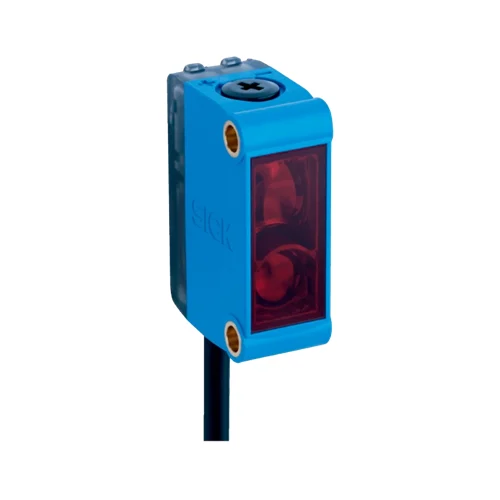
1. Checking a component in a presentation fixture
A fixture can present an opaque component within the configured sensing range and use the NPN output to report its presence to external sequence logic. The five-turn spindle sets the sensing condition with background suppression. Commissioning positions the fixture background behind the target and assesses the actual component remission and separation using the manufacturer’s target-dependent data.
Problem Solved
Background-suppressed proximity sensing provides a component-presentation reference to external sequence logic, helping distinguish the intended nearby target from a more distant fixture background.
Fixture check
Background suppression
NPN output
2. Counting separated pieces on a small feeder
A feeder can move separated opaque pieces through the red sensing spot and send NPN transitions to an external counter. The 1,000 Hz switching rating and response below 625 µs define the timing basis. The mounting bracket supports positioning, while commissioning establishes sufficient piece coverage, target remission and spacing to produce distinct passage events.
Problem Solved
A compact reflected-light sensing point supplies external counting electronics with piece-passage events, helping track separated feeder output without placing a receiver across the path.
Feeder count
1,000 Hz
Mounting bracket
3. Timing a waiting article at an assembly handoff
An assembly handoff can hold an opaque article at a defined sensing position while external control times the selected light-switching output state. A sustained presence beyond the expected transfer interval indicates continued occupancy to that controller. The separate light/dark selector adapts the signal to the station logic, and local LEDs provide supply and received-light context.
Problem Solved
Timing a maintained target-present state gives external handoff logic a basis for recognizing a waiting article and coordinating release of the next assembly.
Handoff occupancy
External timing
Light/dark selection