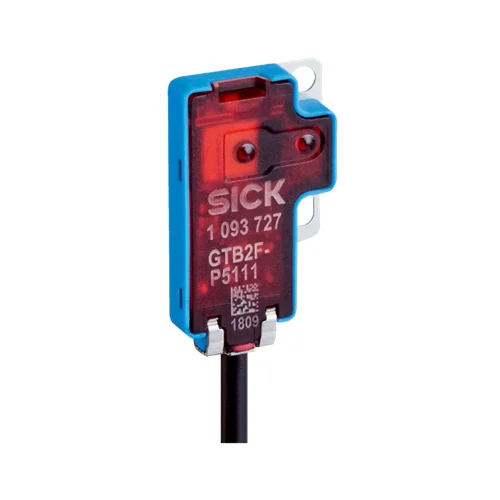
SICK 1093725 GTB2F-N1131 NPN Background-Suppression Sensor

USD 69.68

GTB2F-N1131 offers 1–30 mm reference-white sensing, 660 nm red PinPoint LED, fixed NPN light switching, 800 Hz and a 2 m PVC cable.

SKU SICK-1093725 Category
SICK G2

SICK GTB2F-N1131 NPN Background-Suppression Sensor

BrandSICK
Model IdentifierGTB2F-N1131
Official Part Number1093725

Technical Overview

The SICK GTB2F-N1131 is a flat photoelectric proximity sensor with background suppression and fixed NPN light switching. It provides a 1–30 mm sensing range on 90% remission reference white, with 1–35 mm maximum range. A 660 nm red PinPoint LED forms a 4 mm spot at 30 mm, and the specified minimum detectable object is 0.1 mm at 5 mm distance. This configuration has no adjustment control. Response is below 0.625 ms with resistive load, with 800 Hz switching at a 1:1 light/dark ratio. The 10–30 V DC device uses a 2 m three-wire PVC cable, VISTAL housing and MABS optics, with IP67 protection and operation from −20 to +50 °C.

Flat background-suppression sensor with 1–30 mm reference-white sensing, fixed NPN light switching, 800 Hz and 2 m PVC cable.

Key Features

  • Background-suppression photoelectric sensing in a flat housing
  • 1–30 mm sensing on 90% remission reference white; 1–35 mm maximum
  • 660 nm visible red PinPoint LED; Ø4 mm spot at 30 mm
  • Minimum detectable object 0.1 mm at 5 mm distance
  • Fixed NPN light-switching output; no adjustment control
  • Response <0.625 ms with resistive load; 800 Hz at 1:1 light/dark ratio
  • Output current ≤50 mA; 10–30 V DC supply
  • 2 m three-wire PVC cable; 2.3 mm cable diameter
  • VISTAL housing; MABS optics; IP67; −20 to +50 °C operation
  • Repeatability 0.1 mm with nonconstant ambient temperature; hysteresis <2 mm

Detect small nearby targets with a fixed background-suppression setting and deliver rapid NPN light-switching events through a slim sensing head.

Technical Specification Matrix

ParameterValue
Functional principlePhotoelectric proximity sensing with background suppression
Housing designFlat, rectangular
Sensing range1–30 mm on 90% remission reference white, DIN 5033
Maximum sensing range1–35 mm
Minimum detectable object0.1 mm at 5 mm distance
Light sourceVisible red PinPoint LED; wavelength 660 nm
Average LED service life100,000 h at +25 °C
Light spot sizeØ4 mm at 30 mm
Additional spot sizesØ1 mm at 5 mm; Ø2.5 mm at 15 mm
Other target rangesGray 18% remission: 2–29 mm sensing, 2–35 mm typical maximum; black 6%: 2–28 mm sensing, 2–35 mm typical maximum
AdjustmentNone
Switching outputNPN
Switching modeFixed light switching
Output current≤50 mA
Response time<0.625 ms signal transit time with resistive load
Switching frequency800 Hz at 1:1 light/dark ratio
Repeatability0.1 mm with ambient temperature not constant
Hysteresis<2 mm
Power supply10–30 V DC
Ripple<5 Vpp; remain within supply-voltage tolerances
Current consumption20 mA without load
Connection2 m three-wire PVC cable; do not bend below 0 °C
Cable diameter2.3 mm
Conductor functionsCD-043: BN=L+; BU=M; BK=Q
Circuit protectionSupply reverse-polarity protection; interference suppression; output overcurrent and short-circuit protection
Housing materialVISTAL plastic
Optics materialMABS plastic
Nominal body thickness3.5 mm
Mounting holesØ2.2 mm
IP ratingIP67
Operating temperature−20 to +50 °C
Storage temperature−40 to +70 °C
UL fileNRKH.E348498 and NRKH7.E348498
MTTFD1,107 years
DCavg0%
Mission time20 years
Physical Weight (kg)0.022

Industrial Applications

1. Confirming a small component in an assembly pocket

An assembly pocket can present a component close to the flat sensing head and use the fixed NPN light-switching state as a presence reference. The 0.1 mm minimum detectable object is specified at 5 mm distance, while the documented target ranges guide placement for the actual surface. External inspection samples the output after the component settles in the fixture.

Problem Solved

A localized background-suppression sensing point gives external inspection logic a component-present reference, helping distinguish an occupied assembly pocket from an empty presentation at the commissioned gap.

Assembly presence Small target Fixed setting

2. Counting separated parts on a short-range feed track

A parts feed can pass separated targets close to the flat sensor and provide NPN transitions to external counting electronics. The 800 Hz rating and response below 0.625 ms give the timing basis. Commissioning verifies target coverage, reflectance and spacing at the installed distance, taking the smaller minimum-object specification only at its stated 5 mm condition.

Problem Solved

Short-range optical transitions provide external counting electronics with part-passage events, helping register separated components through a compact sensing point beside the guided feed.

Part count 800 Hz Short-range sensing

3. Monitoring material continuity at a small feeder chute

A compact feeder chute can position the sensor beside a location normally occupied by opaque material. Background suppression supplies a local target condition without an opposing receiver, and external logic times an absence against the normal feeding sequence. The fixed setting requires the installed target and background to produce the intended switching condition within the verified short-range limits.

Problem Solved

A sustained target-absence condition supplies external feeder monitoring with a material-continuity reference, helping request replenishment when the selected chute location remains clear during the process.

Feeder continuity External timing Background suppression

Select your currency