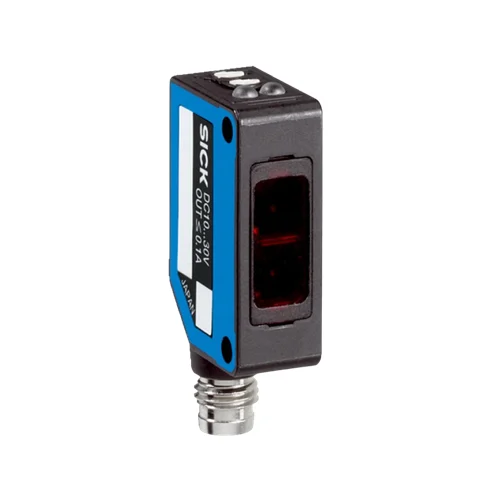
SICK 6030702 WT100L-F1141 PNP Laser Diffuse Sensor

USD 195.00

WT100L-F1141 offers 0–400 mm reference-white sensing, a 2 mm laser spot at 400 mm, single PNP light/dark output, 2,000 Hz and a 2 m cable.

SKU SICK-6030702 Category
SICK W100 Laser

SICK WT100L-F1141 PNP Laser Diffuse Sensor

BrandSICK
Model IdentifierWT100L-F1141
Official Part Number6030702

Technical Overview

The SICK WT100L-F1141 is an energetic laser photoelectric proximity sensor that evaluates light reflected by the target. It provides 0–400 mm sensing and a separately specified 0–450 mm maximum range on 90% remission reference white. Its red laser produces a 2 mm spot at 400 mm. The 650 nm Class 1 laser works with a 270° sensing-range potentiometer and a separate light/dark rotary switch. A single PNP output has response below 0.25 ms with resistive load and a 2,000 Hz switching rating at a 1:1 light/dark ratio. The ABS/PC/POM housing uses PMMA optics, a 2 m three-wire PVC cable and IP65 protection. A stainless steel mounting bracket is supplied.

Energetic laser diffuse sensor with 0–400 mm reference-white sensing, single PNP light/dark output, 2,000 Hz switching and 2 m three-wire PVC cable.

Key Features

  • Energetic diffuse photoelectric sensing from one mounting side
  • 0–400 mm sensing; 0–450 mm maximum on 90% reference white
  • 650 nm visible red Class 1 laser; Ø2 mm spot at 400 mm
  • 270° sensing-range potentiometer; separate light/dark selector
  • Single PNP output; response <0.25 ms with resistive load
  • 2,000 Hz at 1:1 light/dark ratio
  • 10–30 V DC; 30 mA without load; output current ≤100 mA
  • 2 m three-wire PVC cable; ABS/PC/POM housing; PMMA optics; IP65
  • Green power indicator; orange switching-output indicator
  • BEF-W100-A stainless steel 1.4301/304 mounting bracket supplied

Position a small red laser spot from one mounting side and adjust reflected-light detection for an external inspection or counting input.

Technical Specification Matrix

ParameterValue
Functional principleEnergetic diffuse photoelectric sensing
Sensing range0–400 mm on 90% remission reference white, DIN 5033
Maximum sensing range0–450 mm on 90% remission reference white, DIN 5033
Light sourceVisible red laser; 650 nm
Laser class1
Average laser service life50,000 h at +25 °C
AdjustmentSensing-range potentiometer, 270°
Switching outputSingle PNP
Switching modeLight/dark switching selected by separate rotary switch
PNP signal HIGH/LOWSupply voltage −1.8 V / approximately 0 V
Output current≤100 mA
Response time<0.25 ms signal transit time with resistive load
Switching frequency2,000 Hz at 1:1 light/dark ratio
Power supply10–30 V DC; short-circuit-protected network, maximum 8 A
Ripple±10%; remain within supply-voltage tolerances
Current consumption30 mA without load
Connection2 m three-wire PVC cable; do not bend cable below 0 °C
Circuit protectionSupply and input/output reverse-polarity protection; output overcurrent and short-circuit protection
Housing designRectangular
Housing materialABS/PC/POM plastic
Optics materialPMMA plastic
IP ratingIP65
Items suppliedBEF-W100-A stainless steel 1.4301/304 mounting bracket
MountingM3 threaded holes; 25.4 mm spacing in drawing
IndicationGreen: power on; orange: switching output active
Operating temperature−10 to +50 °C
Storage temperature−40 to +70 °C
Manufacturer special applicationsDetecting small objects; detecting objects moving at high speeds
MTTFD438 years
DCavg0%
Conductor cross-section0.18 mm²
Conductor functionsCD-043: BN=L+; BU=M; BK=Q
Light spot sizeØ2 mm at 400 mm
Additional spot sizesØ4 mm at 0 mm; Ø1.5 mm at 300 mm; Ø2.5 mm at 500 mm
Black reference-target ranges6% remission: 25–120 mm sensing; 0–150 mm maximum
Other target upper limits18% gray: 200 mm sensing, 250 mm maximum; 90% white: 400 mm sensing, 450 mm maximum
Physical Weight (kg)0.05

Industrial Applications

1. Checking a small presented component

A fixture can present a small component within the established reflected-light sensing region and use the PNP state as an input to external inspection logic. The laser has a 2 mm spot at 400 mm and a 1.5 mm spot at 300 mm. Setup establishes target coverage, reflectance and background separation with the sensing-range potentiometer; small spot size does not by itself guarantee detection of every small target.

Problem Solved

A localized reflected-light detection point gives external inspection logic a component-presence reference, helping identify an omitted or mispresented part at the fixture’s checked location.

Small-component check Localized laser spot Adjustable detection

2. Counting separated components in a feeder

A feeder can move separated components through the illuminated region and send PNP transitions to an external counter. Target surfaces are assessed using the documented reference-target ranges, while part spacing and speed are checked against the response below 0.25 ms and the 2,000 Hz specification. The single-sided optical arrangement supports installation where no opposite reflector position is available.

Problem Solved

Discrete reflected-light transitions provide external counting electronics with component-passage events, helping track feed quantities from one optical mounting side beside the process.

Feed count 2,000 Hz Single-sided sensing

3. Detecting a lateral edge at a feed station

A feed station can position the laser spot so a laterally moving material edge enters or leaves the illuminated location. The controller uses the resulting PNP transition as a local edge event. Setup fixes sensing distance and checks surface remission, spot coverage and background response; the light/dark selector sets the signal behavior for the external sequence.

Problem Solved

A local optical edge event gives external feed control a position reference, helping coordinate a process step when the material boundary crosses the checked sensing location.

Lateral edge Laser spot External sequencing

Select your currency